
Discover the habits that hold new pianists back and learn simple techniques that will help you read music more confidently and naturally.
How to Read Sheet Music Faster
Many beginners believe they read sheet music slowly because they aren't naturally musical.
Fortunately, that usually isn't the problem.
Learning to read music is much like learning to read a book. At first, every note requires conscious thought. Over time, your brain begins recognizing patterns, intervals, rhythms, and familiar note groupings almost automatically.
The difference between beginners and experienced pianists isn't talent. It's developing good reading habits from the very beginning.
If you've already learned the basics of reading music, avoiding these common mistakes can dramatically improve both your speed and your confidence.
If you're completely new to reading music, start with our guide, How to Read Sheet Music Basics: A Beginner's Guide to Piano Notes, then come back to this article to improve your speed and confidence.
Mistake #1: Looking at Your Hands Instead of the Music
One of the most common beginner habits is constantly looking down at the keyboard.
While it's perfectly normal when you're first learning, relying on your eyes to find every key prevents your reading skills from developing.
Instead, begin trusting your sense of touch. Keep your eyes on the sheet music as much as possible and glance at the keyboard only when necessary.
The more time your eyes spend reading the page, the faster your brain learns to recognize musical patterns.
Piano Wizard Tip
Your goal isn't to eliminate looking at the keyboard. It's to gradually reduce how often you need to.
Mistake #2: Trying to Memorize Every Note
Many beginners think they need to memorize every line and space before they can read music.
That's not how experienced musicians read.
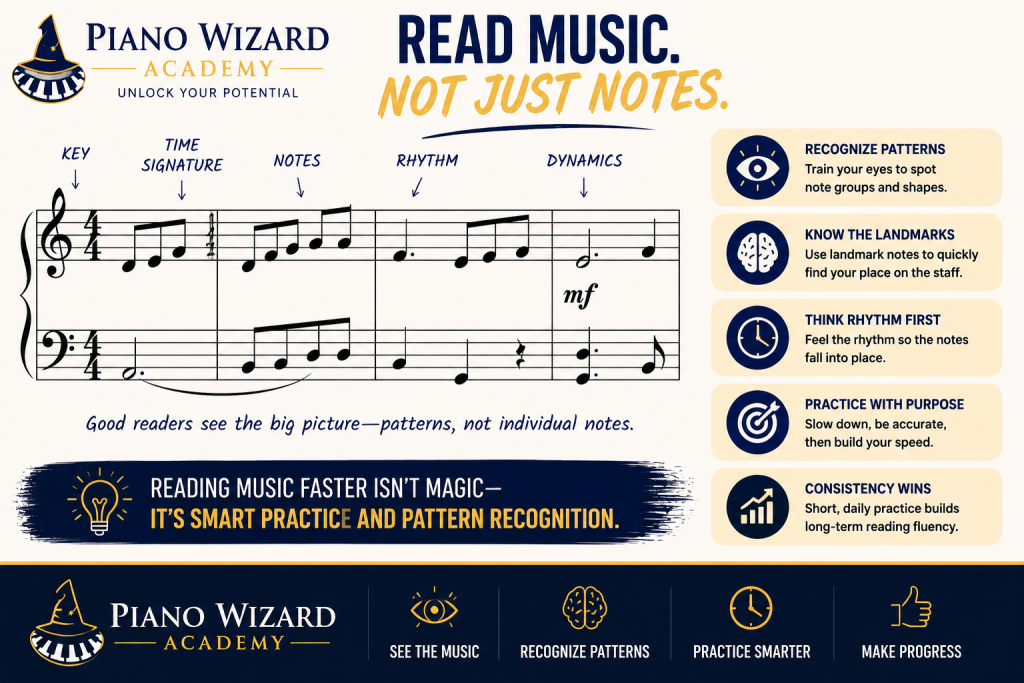
Instead of identifying every note individually, they use landmark notes, intervals, and familiar patterns to recognize groups of notes at a glance.
Start by learning a few important reference points like Middle C, Treble G, and Bass F. Once those become familiar, the surrounding notes become much easier to identify.
The less you rely on memorization, the more naturally you'll begin reading.
Mistake #3: Playing Too Fast
Nearly every beginner tries to play at full speed too soon.
Unfortunately, practicing mistakes only teaches your fingers to repeat those mistakes.
Professional musicians almost always practice difficult passages slowly before gradually increasing the tempo.
Playing slowly isn't a sign of weakness. It's one of the fastest ways to become a better reader.
Accuracy always comes before speed.
Mistake #4: Ignoring Rhythm
Finding the correct notes is only half of reading music.
Rhythm is what transforms those notes into real music.
If you consistently play the correct notes but the song still sounds wrong, rhythm is often the missing piece.
Spend time clapping rhythms before playing them and count aloud whenever possible.
(Later we'll link this section to your future article How to Read Rhythm and Time Signatures.)
Mistake #5: Stopping Every Time You Make a Mistake
Many beginners stop immediately after playing a wrong note.
While it's important to correct mistakes during practice, constantly stopping prevents you from developing the ability to keep a steady rhythm.
When practicing easy music, try continuing to the end of the phrase before going back to fix errors.
This helps develop one of the most important musical skills: recovering gracefully and continuing to play.
Mistake #6: Reading One Note at a Time
Beginning readers often identify each individual note before moving to the next one.
Experienced musicians don't read this way.
Instead, they recognize:
- Scales
- Chords
- Repeated patterns
- Intervals
- Common note groupings
Your goal is to begin seeing groups of notes instead of isolated symbols.
Reading music becomes much faster once your brain starts recognizing these larger patterns.
Mistake #7: Practicing the Same Song Over and Over
Learning one difficult piece can improve your playing, but it doesn't necessarily improve your reading.
To become a stronger music reader, expose yourself to new music regularly.
Even five minutes of reading unfamiliar beginner pieces each day will strengthen your reading skills far more than endlessly repeating songs you've already memorized.
Mistake #8: Writing Letter Names Above Every Note
Many beginners write note names above every symbol on the page.
While this may seem helpful at first, it actually teaches your brain to read the letters instead of the music.
Try using written note names only when absolutely necessary, then gradually remove them as your confidence grows.
The sooner you begin recognizing notes directly, the faster your reading speed will improve.
Mistake #9: Expecting Instant Results
Reading sheet music is a skill that develops over time.
There isn't a shortcut.
Every practice session strengthens the connection between what your eyes see and what your hands play.
Celebrate small improvements.
If today's music feels slightly easier than last week's, you're making excellent progress.
Mistake #10: Forgetting to Enjoy the Music
It's easy to become so focused on reading notes correctly that you forget why you started learning piano in the first place.
Music should be enjoyable.
Play songs you recognize.
Celebrate small victories.
Share your progress with family and friends.
The more enjoyable practice becomes, the more often you'll sit down at the keyboard, and consistent practice is the real secret to becoming a better music reader.
Frequently Asked Questions
Why do I read sheet music so slowly?
Because your brain is still learning to recognize musical patterns. With consistent practice, note recognition becomes much more automatic.
How can I stop looking at my hands?
Practice simple songs slowly while keeping your eyes on the sheet music. Over time, your fingers will begin finding familiar keys without constant visual guidance.
Should I memorize every note?
No. Focus on learning landmark notes and recognizing patterns instead of memorizing every position individually.
How often should I practice reading music?
Even 10 to 15 minutes of reading new music every day can lead to noticeable improvement over time.
Learn Piano the Easy Way
Reading sheet music is only one part of becoming a confident pianist.
At Piano Wizard Academy, we've helped thousands of beginners learn piano through a simple, step-by-step system that makes reading music easier, builds confidence, and keeps learning enjoyable.
Whether you're just starting your musical journey or returning to piano after many years away, our lessons are designed to help you succeed at your own pace.
Continue your journey:
- How to Read Sheet Music Basics
- Free Beginner Piano Lessons
- Student Success Stories
- Discover the Piano Wizard Learning System
Reading sheet music is a skill that develops through consistent practice and pattern recognition, not memorization alone. Every accomplished musician began by learning the same basic symbols and gradually recognizing them more quickly over time. If you'd like to learn more about how standard music notation works, the Library of Congress guide to reading music notation provides an excellent overview of the system musicians have used for centuries.
Final Thoughts
Every accomplished pianist once struggled to recognize notes, count rhythms, and keep their eyes on the music instead of the keyboard.
The difference wasn't natural talent. It was consistent practice and good learning habits.
Avoid these common mistakes, practice patiently, and you'll soon discover that reading sheet music becomes easier, faster, and far more enjoyable than you ever imagined.
Your next song might still challenge you, but it won't intimidate you.
If you're still learning the fundamentals, be sure to read our complete guide, How to Read Sheet Music Basics: A Beginner's Guide to Piano Notes, where you'll learn the Grand Staff, note names, the Treble and Bass Clefs, time signatures, and other essential skills every beginner should know.
Coming Next
How to Read Rhythm and Time Signatures
Learn how note values, rests, measures, and time signatures work together to help you play music with confidence and accuracy.