
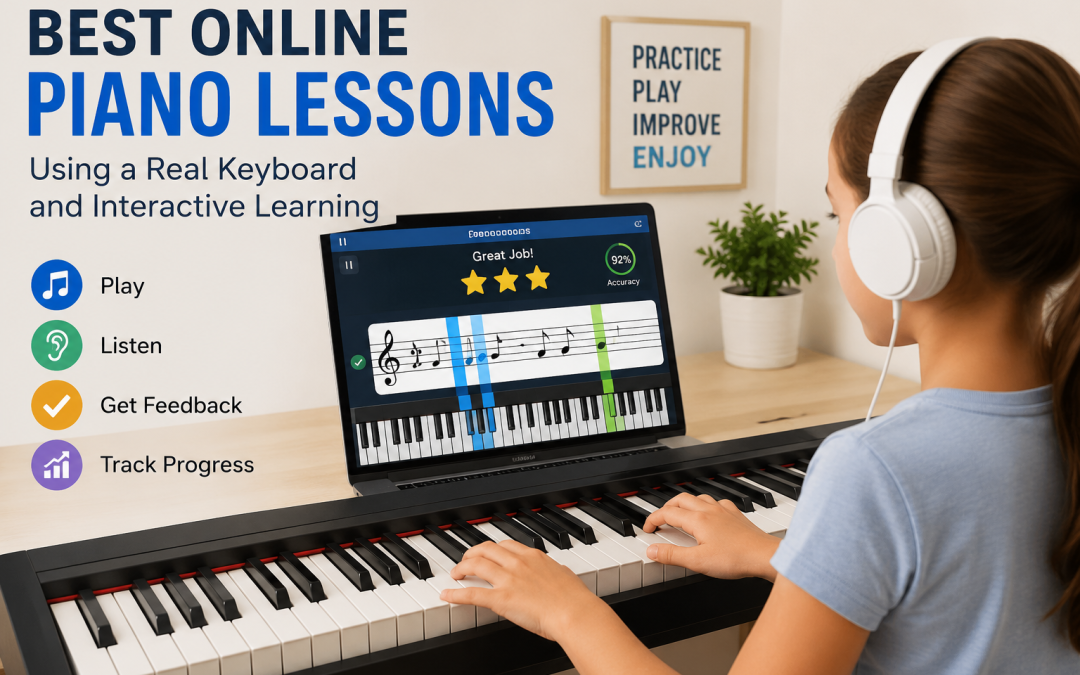
Best Online Piano Lessons: How to Choose the Right Program
The Best online piano lessons should get students playing regularly, provide useful feedback, and build real skills on an actual keyboard. This guide compares the major online learning approaches so you can choose the right one.
If you are searching for the best online piano lessons, you will quickly discover that not all programs teach piano the same way.
Some rely on prerecorded videos. Others use apps, interactive exercises, live teachers, or software that connects directly to a real piano or MIDI keyboard.
The best choice depends on who is learning, how they prefer to learn, what equipment they already have, and whether the goal is simply to play songs or develop broader piano skills over time.
This guide explains the main types of online piano lessons, what features matter most, and how to decide which approach fits you or your child.
What Are Online Piano Lessons?
Online piano lessons use a computer, tablet, or other connected device to teach piano outside a traditional in-person lesson.
Depending on the program, lessons may include:
- Video demonstrations
- Interactive exercises
- Live video instruction
- Game-based activities
- Song libraries
- Music-reading lessons
- Real-time keyboard feedback
- Self-paced practice
The term covers several very different learning experiences, so comparing programs only by price or song selection can be misleading.
What Makes the Best Online Piano Lessons?
The best online piano lessons should do more than provide something interesting to watch.
A strong program should help the student actually play.
Look for features such as:
- Clear beginner instruction
- Regular keyboard practice
- Useful feedback
- Progressive difficulty
- Rhythm training
- Keyboard awareness
- Music-reading development
- Easy repetition
- A learning style that keeps the student engaged
The right program should fit the learner rather than forcing every learner into the same teaching method.
The Best Online Piano Lessons for Beginners and Kids
1. Video-Based Online Piano Lessons
Video lessons are one of the most common forms of online piano instruction.
An instructor demonstrates a technique, song, scale, or musical concept, and the student follows along at home.
Advantages
- Easy to access
- Can be paused and replayed
- Often organized into structured courses
- Useful for visual learners
- Can include excellent teacher demonstrations
Limitations
A prerecorded video generally cannot tell whether you played the correct note, rhythm, or fingering.
The lesson demonstrates what to do, but the student has to evaluate their own playing.
For independent learners, that may be enough. Others may benefit from a more interactive approach.
2. Interactive Piano Lessons
Interactive lessons make the student's playing part of the lesson itself.
Compatible software may respond to what is played on a digital piano or MIDI keyboard.
That changes the learning cycle from:
Watch → pause → imitate
to something closer to:
See → play → hear → receive feedback → try again.
If that approach interests you, see our guide to interactive piano lessons.
3. MIDI Keyboard Piano Lessons
A MIDI-connected keyboard can make online learning much more responsive.
MIDI allows a compatible keyboard or digital piano to communicate information about what you play to learning software.
This can help the program recognize notes and incorporate your keyboard directly into exercises.
For beginners, this creates an important connection between what appears on the screen and what happens under their fingers.
Read our complete guide on how to learn piano online with MIDI keyboard.
4. App-Based Piano Lessons
Piano learning apps vary widely.
Some provide video lessons. Others use on-screen keyboards, microphones, MIDI connections, games, or combinations of several approaches.
Before choosing an app, ask:
- Does it work with a real piano or keyboard?
- Does it respond to what I play?
- Does it teach rhythm?
- Does it introduce music notation?
- Does it provide a structured progression?
- Is most practice happening on the instrument or on the screen?
A polished app is not automatically a complete piano-learning system.
5. Game-Based Piano Lessons
Game-based learning can make piano practice more appealing, especially for children.
Games can provide:
- Clear goals
- Immediate feedback
- Progress indicators
- Challenges
- Built-in repetition
The important question is whether the game teaches skills that transfer to the instrument.
A useful piano game should help develop things such as rhythm, keyboard awareness, note recognition, coordination, and eventually music reading.
You can see this approach in our piano keyboard game.
6. Live Online Piano Teachers
Live online lessons connect the student with a real teacher through video conferencing.
This is the closest online equivalent to a traditional private lesson.
Advantages
- Personalized instruction
- Direct feedback
- Questions can be answered immediately
- Teacher can adjust lesson pacing
- Useful for technique and interpretation
Limitations
- Usually more expensive
- Requires scheduled appointments
- Quality depends heavily on the teacher
- Internet delays can affect musical interaction
For some students, live lessons are ideal. Others prefer a flexible self-paced program, especially at the beginning.
Online Piano Lessons for Kids
Children often need something different from adult learners.
A child may understand the musical concept but lose interest before enough repetition occurs to master it.
Programs designed for children often benefit from:
- Short activities
- Visual feedback
- Games
- Clear goals
- Visible progress
- Frequent opportunities to play
The best online piano lessons for kids should make practice engaging without turning the instrument into nothing more than a video game controller.
The student should still be developing real piano skills.
Online Piano Lessons for Beginners
A beginner should not need to understand everything about music before playing the first song.
Traditional piano learning can introduce several ideas immediately:
- Staff notation
- Finger numbers
- Note names
- Rhythm
- Hand position
- Keyboard geography
Those skills matter, but introducing too many at once can overwhelm a new player.
Good beginner piano lessons should break learning into manageable steps and get the student playing early.
Should Online Piano Lessons Use a Real Keyboard?
If the ultimate goal is to play piano, spending time on a real keyboard matters.
Touchscreen piano apps may introduce notes and musical ideas, but tapping a flat screen does not teach the physical layout of an instrument.
A real keyboard develops familiarity with:
- Key spacing
- Black and white key patterns
- Finger movement
- Hand coordination
- Playing several notes together
- Moving across the instrument
This is why many interactive systems use a digital piano or MIDI keyboard as part of the lesson.
Do You Need an 88-Key Piano?
No.
Beginners can learn successfully on smaller keyboards.
Common sizes include:
- 49 keys
- 61 keys
- 76 keys
- 88 keys
A 61-key keyboard can provide plenty of range for early lessons, while an 88-key digital piano offers the complete piano keyboard and may be preferable for long-term study.
If you're choosing an instrument, Yamaha's digital keyboard buying guide provides a useful overview of keyboard size, touch sensitivity, connectivity, and beginner considerations.
How Important Is Feedback?
Feedback is one of the biggest differences between online learning systems.
A video cannot usually tell whether you played a wrong note.
An interactive program may be able to respond directly to keyboard input.
A live teacher can provide even more detailed feedback on technique, posture, phrasing, and interpretation.
When comparing programs, consider how much feedback the student actually receives.
Look for a Path Toward Reading Music
Visual learning can make the first stages of piano much easier to understand.
Colors, falling notes, patterns, and other visual systems can help beginners connect the screen with the keyboard.
But those cues should ideally lead somewhere.
A strong system should gradually help the student understand:
- Notes on the staff
- Rhythm notation
- Keyboard locations
- Musical patterns
- Independent song playing
The technology should become a bridge into music rather than something the student can never play without.
How Much Should Online Piano Lessons Cost?
Costs vary considerably depending on the type of instruction.
Programs may use:
- Monthly subscriptions
- Annual subscriptions
- One-time software purchases
- Individual course purchases
- Per-lesson fees for live teachers
Do not compare price alone.
A cheaper program that nobody uses is not a bargain, while an expensive program may offer features the student never needs.
Consider the amount of actual instruction, practice, feedback, and progression provided.
Online Piano Lessons vs. Private Lessons
| Online Piano Lessons | Traditional Private Lessons |
|---|---|
| Learn from home | Usually travel to teacher or studio |
| Often self-paced | Teacher sets lesson pace |
| Lessons can often be repeated | Direct personal instruction |
| Can include games and software feedback | Teacher can correct technique directly |
| Usually flexible scheduling | Usually scheduled weekly |
The approaches do not have to compete.
Some students use online lessons to begin, then add a private teacher as their skills become more advanced.
Online Piano Lessons vs. Piano Learning Software
These terms overlap, but they are not always the same thing.
Online piano lessons may simply mean lessons delivered over the internet.
Piano learning software may provide a more interactive environment that responds to the student.
If you're specifically comparing software-based approaches, see our guide to the best piano learning software.
How Piano Wizard Fits Into Online Piano Learning
Piano Wizard takes a different approach from lessons built primarily around watching an instructor.
The student plays a real MIDI-connected keyboard while interacting with a visual learning environment.
The early experience connects:
- What the student sees
- What they hear
- What they play
- When they play it
This allows beginners to start making music before traditional notation becomes the entire focus of the lesson.
As the student progresses, the visual system is designed to transition toward standard music notation.
The objective is not simply to become good at a game.
The objective is to use the game as a pathway into playing music.
Questions to Ask Before Choosing Online Piano Lessons
Before choosing a program, ask:
- Will the student play a real keyboard?
- Is the program appropriate for the student's age?
- Does it provide useful feedback?
- Can lessons be repeated easily?
- Does it teach rhythm?
- Does it develop keyboard awareness?
- Does it eventually teach music reading?
- Does the learning style keep the student engaged?
- Does it work with the equipment you already own?
- Is there a clear progression beyond the beginner stage?
Frequently Asked Questions
What are the best online piano lessons for beginners?
The best program for a beginner should provide clear instruction, regular opportunities to play, manageable progression, and a learning style the student is willing to use consistently.
Can you really learn piano online?
Yes. Online programs can teach beginner and intermediate piano skills through video, interactive exercises, live instruction, or combinations of these approaches. More advanced students may eventually benefit from direct feedback from an experienced teacher.
Are online piano lessons good for kids?
They can be especially useful for children when lessons are short, engaging, interactive, and designed around regular keyboard play.
Do online piano lessons require a MIDI keyboard?
No. Some lessons work with acoustic pianos or conventional keyboards. MIDI becomes useful when software needs to recognize what the student is playing.
Are online piano lessons better than apps?
It depends on the program. Some apps are complete learning systems, while others are simple games or video libraries. Compare the actual teaching method rather than the format alone.
How often should a beginner practice?
Short, consistent practice is generally more useful than infrequent marathon sessions. For young beginners, even 10 to 20 focused minutes can be a practical starting point.
Finding the Best Online Piano Lessons for You
The best online piano lessons are not necessarily the program with the largest song library, the flashiest graphics, or the longest feature list.
The best system is the one that gets the student to sit at the keyboard, play regularly, understand what they are doing, and continue progressing.
Look for a program that fits the learner, provides a clear path forward, encourages actual keyboard play, and gradually develops skills that can exist beyond the screen.
Piano Wizard combines a real MIDI keyboard, visual learning, interactive feedback, and game-based practice to help beginners start playing and gradually move toward reading traditional music.
Explore Piano Wizard Academy and see whether interactive, game-based piano learning is the right fit for your family.