
Compare Piano Learning Methods: Which Is Right for You?
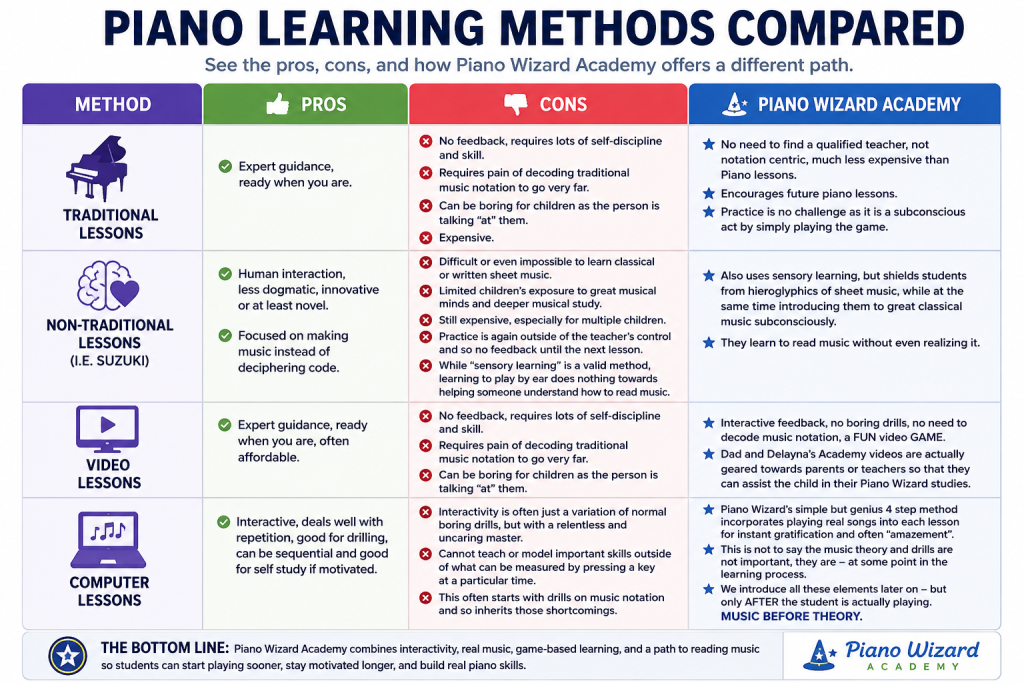
If you want to compare piano learning methods, the most useful question is not simply, "Which one is best?" It is, "Which one fits the person who will actually be sitting at the piano?"
A private teacher can provide personal feedback. Video lessons offer flexibility. Piano apps can make practice convenient. Interactive software can respond to what a student plays. Game-based systems can make repetition more engaging.
Each approach solves a different part of the learning problem.
This comparison looks at those differences side by side so you can decide which approach makes the most sense for you or your child.
Quick Comparison of Piano Learning Methods
| Learning Method | Best For | Feedback | Flexibility | Real Keyboard |
|---|---|---|---|---|
| Private Piano Lessons | Students who benefit from personal instruction | Excellent | Usually scheduled | Yes |
| Video Piano Lessons | Independent visual learners | Limited | Excellent | Usually |
| Piano Apps | Convenience and casual learning | Varies | Excellent | Depends on app |
| Interactive Piano Software | Students who want active feedback and repetition | Interactive | Excellent | Often |
| Game-Based Piano Learning | Kids and learners who need motivation | Varies by system | Excellent | Depends on program |
| Method Books | Structured, self-directed learners | None without teacher | Excellent | Yes |
For a deeper explanation of how each method works, see our complete guide to piano learning methods.
Which Method Provides the Best Feedback?
This is one of the biggest differences between learning approaches.
Private Lessons
A skilled teacher provides the most complete form of feedback because they can observe things software may not easily evaluate, including:
- Posture
- Hand position
- Fingering
- Dynamics
- Phrasing
- Interpretation
Video Lessons
Video instruction shows the student what correct playing should look and sound like, but most prerecorded lessons cannot evaluate what the student actually plays.
The student usually follows this process:
Watch → try → listen → decide whether it was correct.
Interactive Software
Compatible software can provide a different type of feedback by responding to keyboard input.
The process can become:
See → play → receive feedback → repeat.
This does not replace every type of teacher feedback, but it can make independent practice far more responsive.
See how this works in our guide to interactive piano lessons.
Which Piano Learning Method Is Most Flexible?
Private piano lessons normally require a scheduled appointment.
Books, videos, apps, and software allow students to practice whenever they want.
That difference matters for families with changing schedules.
A student using self-paced software can:
- Practice before school
- Practice after dinner
- Repeat a lesson several times
- Stop when attention begins to fade
- Return later without falling behind a class
For many families, flexibility is one of the main reasons to consider online or software-based piano learning.
Private Piano Lessons vs Piano Software
This does not have to be an either-or decision.
A private teacher and piano software are good at different things.
| Private Teacher | Piano Software |
|---|---|
| Personal technique correction | Unlimited repetition |
| Human interpretation and guidance | Practice whenever convenient |
| Customized repertoire | Interactive visual exercises |
| Scheduled instruction | Self-paced instruction |
| Ongoing lesson cost | Often lower ongoing cost |
A student can also use both. Software can provide regular home practice while a teacher provides periodic personal guidance.
Piano Apps vs Interactive Piano Software
The terms are often used interchangeably, but they can describe very different products.
Some piano apps are primarily:
- Video libraries
- Touchscreen games
- Song tutorials
- Practice tools
Other systems connect directly to a digital piano or MIDI keyboard and use the student's playing as part of the lesson.
When comparing them, ask:
- Does it work with a real keyboard?
- Does it recognize what the student plays?
- Does it teach rhythm?
- Does it develop keyboard awareness?
- Does it eventually introduce music notation?
- Is the student actually playing or mostly watching?
Our best piano learning software guide goes deeper into those differences.
Video Piano Lessons vs Interactive Lessons
Video lessons can be excellent for explaining concepts.
You can see how a teacher positions the hand, hear a musical example, and replay an explanation as many times as necessary.
The main difference is interaction.
A prerecorded video generally does not know whether you played C, C-sharp, or nothing at all.
Interactive lessons can make the student's keyboard part of the learning process.
That distinction becomes especially important during independent practice.
Which Piano Learning Method Is Best for Kids?
Children often need more than good information. They need a reason to repeat it.
Learning piano involves repetition:
- Repeating notes
- Repeating rhythms
- Repeating finger movements
- Repeating difficult sections
A child who enjoys the repetition is more likely to keep practicing.
For that reason, visual and game-based systems can be particularly useful for younger learners.
But engagement alone is not enough.
The activity should still develop skills that transfer to the piano.
Game-Based Piano Learning vs Ordinary Piano Games
There is an important difference between a game that contains piano keys and a game designed to teach piano.
A useful learning game should connect game progress with musical skills such as:
- Timing
- Pitch
- Keyboard location
- Finger coordination
- Listening
- Music reading
The game is valuable because it makes the necessary repetition more engaging.
It should not become a substitute for musical development.
See our piano keyboard game for more about this approach.
Which Method Gets Beginners Playing Fastest?
Some methods begin with theory and notation. Others begin with playing.
Neither approach is inherently wrong, but they create different first experiences.
A notation-first method may ask a beginner to understand:
- Treble clef
- Bass clef
- Note names
- Rhythm values
- Finger numbers
- Keyboard location
before the student feels comfortable playing much music.
Visual and interactive approaches can reverse that sequence by allowing the beginner to play first and gradually connect that experience with notation and theory.
If speed of initial progress is particularly important to you, we also have a separate guide examining the best way to learn piano.
Which Method Is Best for Learning to Read Music?
Traditional lessons and method books often introduce music notation early.
That can create a strong foundation for students who are comfortable processing written music from the beginning.
Other approaches introduce notation later.
The question is not necessarily when notation appears.
The important question is whether the method eventually connects playing with conventional written music.
A visual learning system should act as a bridge toward music reading rather than a system the player can never move beyond.
 Do You Need a Real Piano or Keyboard?
If the long-term goal is to play piano, practicing on a physical keyboard has obvious advantages.
A real keyboard develops familiarity with:
- The spacing between notes
- Black and white key patterns
- Finger movement
- Hand position
- Playing several notes together
- Moving across the keyboard
Some digital learning systems connect directly to a MIDI-capable piano or keyboard.
If you're choosing a digital piano or keyboard for lessons, Yamaha's digital keyboard buying guide explains useful beginner considerations such as keyboard size, touch sensitivity, and connectivity.
If you are considering that approach, read our guide on how to learn piano online with MIDI keyboard.
How Piano Wizard Compares
Piano Wizard combines elements from several piano learning methods.
It uses:
- A real MIDI-connected piano or keyboard
- Interactive visual learning
- Game-based repetition
- Self-paced practice
- Immediate interaction with the student's playing
- A progression toward traditional music notation
The student begins by making a direct connection between:
Seeing → hearing → playing → timing.
Instead of requiring beginners to decode traditional notation before they can experience playing songs, Piano Wizard uses visual interaction as an entry point.
As the student progresses, that visual information is connected with conventional music notation.
Where Piano Wizard Is Different
Piano Wizard is not simply a library of instructional videos.
It is not a touchscreen piano game.
And it is not intended to imitate a private teacher.
Its strength is combining a real instrument with interactive game-based learning.
The student is actively playing rather than primarily watching.
That makes Piano Wizard particularly suited to beginners who respond well to:
- Visual learning
- Immediate feedback
- Games
- Repetition
- Self-paced instruction
- Learning by doing
When a Traditional Piano Teacher May Be the Better Choice
There are situations where a private teacher may be especially valuable.
For example:
- Advanced classical repertoire
- Detailed technique correction
- Performance preparation
- Advanced interpretation
- Individualized physical adaptations
Using Piano Wizard does not prevent a student from working with a teacher later or even at the same time.
In fact, an engaged beginner who already enjoys playing may arrive at traditional lessons with greater enthusiasm for the instrument.
How to Compare Piano Learning Methods for Your Family
When you compare piano learning methods, consider the student rather than choosing entirely by tradition, technology, or price.
Ask these questions:
- Does the student prefer learning by watching, reading, listening, or doing?
- How much personal feedback is needed?
- Will the student practice without external motivation?
- Does the schedule allow weekly appointments?
- Will the student use a real keyboard?
- Is repetition likely to become frustrating?
- Does the method lead toward reading music?
- Can the student repeat difficult material easily?
- Does the method fit your budget?
- Most importantly, will the student want to keep using it?
There Does Not Have to Be One Winner
The most effective approach may be a combination.
A student might use:
- Interactive software for everyday practice
- A teacher for technique
- Videos for demonstrations
- Books for music reading
- Ear training for listening skills
The methods do not have to compete when combining them produces a better learning experience.
If you want a broader overview before choosing, read our guide to the four common approaches to learning piano.
Compare Piano Learning Methods Before You Choose
When you compare piano learning methods, there is no universal winner.
Private teachers provide detailed personal instruction. Video lessons provide convenient demonstrations. Books offer structure. Interactive software provides responsive practice. Games can make repetition more engaging.
The right approach is the one that matches the learner while continuing to develop real musical skills.
Piano Wizard offers another option by combining interactive software, game-based learning, and a real keyboard with a pathway toward traditional music reading.
Explore Piano Wizard Academy and see whether learning by playing is the right fit for your family.