
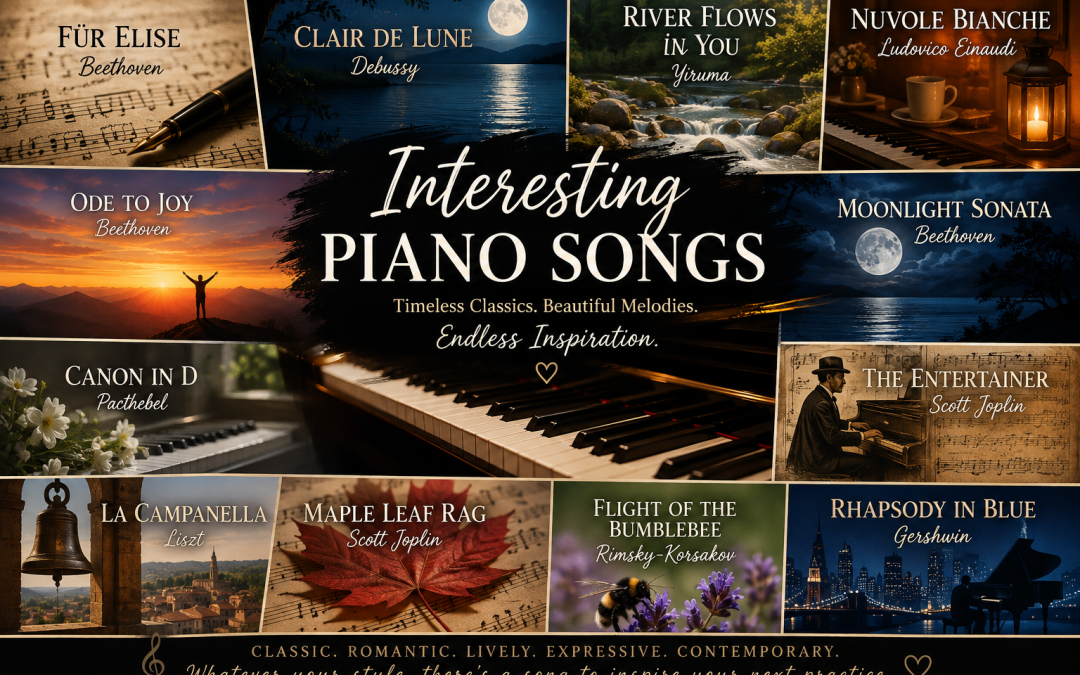
Interesting piano songs can make the difference between practice that feels repetitive and practice you actually look forward to.
The right piece gives you something to work toward. It might be a melody you already recognize, a rhythm that makes you want to keep playing, or a song that is just challenging enough to push your skills without becoming frustrating.
Whether you are a beginner, an intermediate player, or a more experienced pianist looking for new inspiration, here are some piano songs and pieces worth exploring.
What Makes a Piano Song Interesting?
Not every memorable piano piece is difficult.
Some of the most interesting piano songs combine a recognizable melody with just enough challenge to keep the player engaged.
A good practice piece might offer:
- A melody you enjoy hearing
- A rhythm that feels satisfying to play
- A new technical challenge
- Patterns that become easier with repetition
- A sense of progress as the piece comes together
The best song for motivation is not necessarily the most impressive one. It is the piece that makes you want to sit down at the piano again tomorrow.
Interesting Piano Songs for Beginners
Beginners benefit from songs that sound familiar without demanding advanced technique.
Ode to Joy - Beethoven
Beethoven's Ode to Joy is one of the most recognizable melodies in classical music and works well for beginners because the basic tune can be learned with a relatively small number of notes.
It is a good piece for practicing rhythm, note recognition, and playing a melody smoothly.
Heart and Soul
Heart and Soul has been a favorite beginner piano piece for generations.
Its repeating patterns make it approachable, and it can also be played as a duet, making it especially fun for families or young learners.
Chopsticks
Although simple, Chopsticks remains popular because beginners can recognize progress almost immediately.
That early success can be important when someone is first learning the keyboard.
If you are just getting started, you can also explore our guide on how to practice piano more effectively.
Interesting Piano Songs for Intermediate Players
Once basic keyboard skills become more comfortable, intermediate players can begin exploring pieces with greater expression, coordination, and technical variety.
Für Elise - Beethoven
Für Elise is one of the world's most familiar piano pieces.
The opening section is approachable for many developing players, while later sections offer additional challenges as skills improve.
Clair de Lune - Debussy
Clair de Lune is admired for its flowing character and expressive sound.
It requires more control than a typical beginner piece, making it a rewarding goal for pianists developing touch, phrasing, and dynamics.
Canon in D - Pachelbel
Originally written for strings, Canon in D has become a popular piano arrangement because of its repeating harmonic structure and memorable melody.
It can be a useful piece for developing coordination while still sounding musical throughout the learning process.
Interesting Piano Pieces for Advanced Players
Advanced pianists often stay motivated by pieces that combine technical demands with distinctive musical personalities.
Rhapsody in Blue - George Gershwin
Gershwin's Rhapsody in Blue blends classical writing with jazz harmony and rhythm.
It is technically demanding, but its variety makes it an exciting long-term project for experienced players.
La Campanella - Franz Liszt
La Campanella is famous for its technical difficulty, including rapid passages and large jumps across the keyboard.
It is not a casual practice piece, but for advanced pianists it can provide a serious challenge and a clear technical goal.
The Entertainer - Scott Joplin
Scott Joplin's The Entertainer combines a memorable melody with the syncopated rhythms of ragtime.
It is lively, recognizable, and excellent for players who want to develop rhythmic independence between the hands.
Lively Piano Songs That Make Practice More Fun
Sometimes motivation comes from energy.
If slow practice pieces are beginning to feel stale, a lively song can make sitting down at the keyboard feel fresh again.
Maple Leaf Rag - Scott Joplin
Maple Leaf Rag is one of the best-known works of ragtime.
Its syncopated rhythms and energetic character make it both challenging and rewarding.
Rondo Alla Turca - Mozart
Often called the Turkish March, Mozart's Rondo Alla Turca is fast, rhythmic, and instantly recognizable.
It is a useful piece for developing articulation, control, and speed while still feeling playful.
Flight of the Bumblebee - Rimsky-Korsakov
Flight of the Bumblebee is famous for speed.
Although originally written for orchestra, piano arrangements challenge players to maintain accuracy and control through rapid passages.
Beautiful Piano Songs for Expressive Playing
Not every motivating piece needs to be fast.
Some pianists are drawn to music because it gives them a chance to work on expression, dynamics, phrasing, and tone.
Moonlight Sonata - Beethoven
The opening movement of Beethoven's Moonlight Sonata is one of the most recognizable examples of expressive piano writing.
Its slower tempo does not make it simple. The challenge is maintaining control, balance, and atmosphere throughout the piece.
Nocturne in E-flat Major, Op. 9 No. 2 - Chopin
Chopin's famous nocturne offers an opportunity to work on melodic phrasing and expressive timing.
The flowing right-hand melody and accompaniment make it a favorite among pianists who enjoy more lyrical playing.
River Flows in You - Yiruma
River Flows in You has become one of the most recognizable contemporary piano pieces.
Its repeating patterns and emotional character make it appealing to developing pianists who want something modern and expressive.
Contemporary Piano Songs Worth Exploring
Classical music is only one part of the piano repertoire.
Contemporary piano music can offer repeating patterns, minimalist textures, cinematic sounds, and styles influenced by pop, jazz, and electronic music.
Nuvole Bianche - Ludovico Einaudi
Einaudi's Nuvole Bianche is built around repeating patterns that gradually develop in intensity.
That makes it useful for working on control, dynamics, and maintaining a steady flow across repeated figures.
Explore Different Styles
Do not limit yourself to one kind of piano music.
Try classical, ragtime, jazz, pop arrangements, film music, contemporary instrumental pieces, and even music from video games.
The more styles you explore, the more likely you are to discover music that makes you want to keep practicing.
How to Choose Piano Songs That Keep You Motivated
The most interesting piano songs are not necessarily the most famous ones.
Choose music based on what makes you want to play.
Look for a piece that:
- You genuinely enjoy listening to
- Is slightly above your current skill level
- Contains at least one new skill to learn
- Can be broken into manageable sections
- Sounds rewarding even before you have mastered the entire piece
If a piece is so difficult that every practice session becomes frustrating, put it aside temporarily and choose something more manageable.
You can always return to it later.
Use Songs to Build Real Piano Skills
A song can do more than keep practice interesting.
Different pieces naturally develop different skills.
- Ragtime develops rhythmic independence
- Classical pieces can strengthen phrasing and technique
- Contemporary music often reinforces repeating patterns
- Simple melodies help beginners build note recognition
- Duets help develop timing and listening
Instead of treating technique and songs as completely separate activities, use the music you enjoy to give technical practice a purpose.How to Play Piano for Beginners: A Complete Beginner’s Guide
Make Playing the Piano Something You Want to Do
Learning piano requires repetition, but repetition does not have to mean boredom.
The right repertoire gives you a reason to practice.
Start with music you enjoy.
Choose pieces that challenge you without overwhelming you.
Celebrate the small improvements along the way.
And if you are helping a child learn piano, let them have some say in what they play. Interest is one of the strongest reasons to return to the keyboard.
For more background on the instrument itself, Britannica offers a concise overview of the history and development of the piano.
Explore Piano Wizard Academy and see how game-based learning helps beginners start playing real music while building keyboard and music-reading skills.