
In This Article
Music is a universal language, a God-given joy meant for all of humanity. But as we have discussed before, there can be a sizable gap between wanting to make music and learning the "language" required to create it. So let us explore further.
For many people, music education begins at the piano. The keyboard presents notes in a clear visual arrangement, and a student can go as deeply into piano as he or she wishes. A strong musical foundation at the piano can also be useful when moving on to guitar, flute, voice, or any number of other instruments.
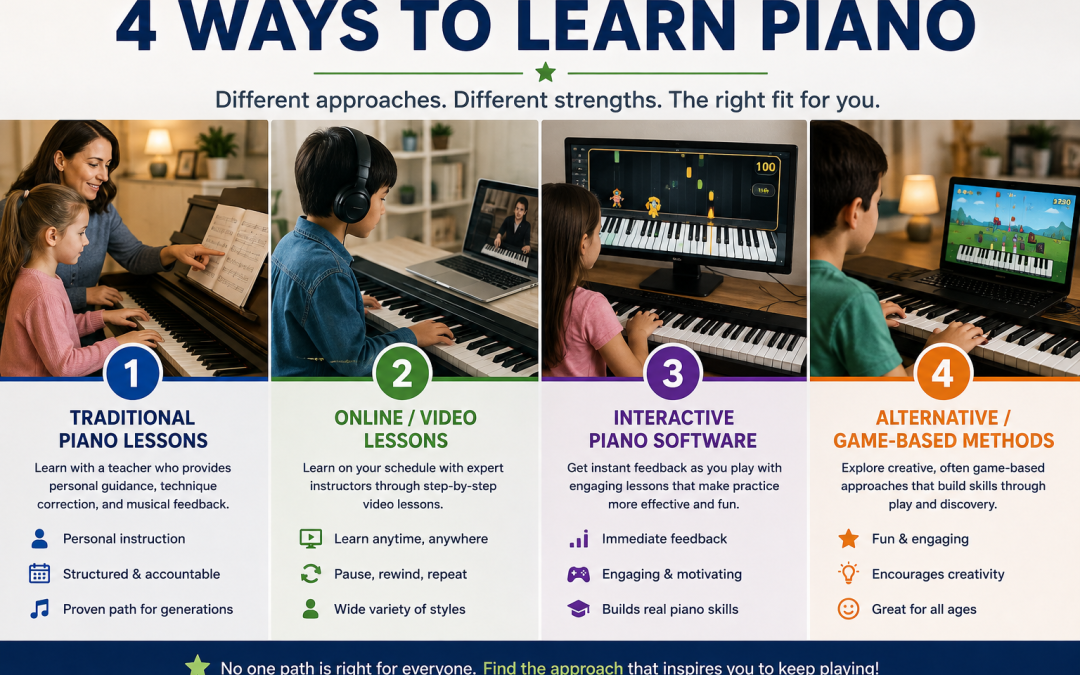
There are now more ways to learn piano than ever before. But most still fall into a few broad categories.
Let's take a look at four common approaches to learning piano for an aspiring new player.
1. Traditional Piano Lessons
Of course, the first thought that typically comes to mind when looking to teach our children piano, or learn ourselves, is: "Hey! Let's get a piano teacher."
Then come the questions:
- How do I know the teacher is good at what she does?
- She may play well, but can she teach well?
- Will my children even like her?
There are as many styles of teaching as there are teachers, and finding the right one for you or your children can be a lot like finding the perfect mate. A friend may recommend a teacher who suited her perfectly but who may not necessarily mesh well with your child.
One teacher may insist on perfecting a single piece before moving on, which can be wonderful for one student and painfully slow for another. Another teacher may provide so much freedom that a child who needs more structure begins to drift.
You may have to try several teachers until you find one that's just right. Maybe we should call this the Goldilocks Method.
Even after finding that special teacher, getting schedules to cooperate can become a new circus juggling trick for parents, especially when more than one child is involved and someone has to drive back and forth to lessons.
The Mrs. Williams Problem
Many adults also remember the classic, almost caricatured piano teacher from childhood. We'll call her Mrs. Williams.
Mrs. Williams comes to your home once a week, or perhaps your children go to her little studio down the street for half an hour. She explains musical notation. Your child tries to read it. She corrects the mistakes and sends the child home to practice.
Then comes the real challenge: Mrs. Williams isn't there during the other six days of the week.
If the student misunderstands something and repeats it incorrectly, the next lesson may begin by undoing what was practiced at home.
That isn't really Mrs. Williams' fault. A teacher cannot supervise every practice session, and many teachers today use creative, flexible approaches that go far beyond the stereotype.
Still, the underlying problem is real. Traditional instruction can place a great deal of responsibility on the student and family between lessons.
And when the early emphasis is heavily centered on decoding notation before making satisfying music, some beginners can lose enthusiasm before they discover why they wanted to play in the first place.
On the other hand, finding the right piano teacher can change a life. A great teacher can model musicianship, correct technique, answer questions immediately, inspire a student through difficult periods, and create a lifelong love of music.
Traditional Piano Lessons: Pros and Cons
Pros: Human interaction, individualized guidance, technique correction, musical modeling, accountability, and the ability to answer questions immediately.
Cons: Finding the right teacher can take time. Lessons can become expensive for multiple children, scheduling can be inconvenient, and most practice still happens outside the teacher's direct supervision.
Traditional lessons can be extremely effective. Much depends on the teacher, the student, and how well the two fit together.
2. Non-Traditional Piano Lessons
Another option is to learn through approaches that do not place traditional music notation at the center of the very first lesson.
These methods may emphasize improvisation, learning by ear, chord patterns, imitation, colors, numbers, letter names, or other visual systems that allow students to begin making music sooner.
That immediate experience can be powerful.
A beginner who can actually play something recognizable may suddenly think, "Wait a minute. I can do this."
That moment matters.
Playing First, Reading Later
The Suzuki approach is probably the best-known example of the broader idea of playing before reading. Students initially learn heavily through listening, imitation, repetition, and performance, with reading introduced as their musical development continues.
There is a logic to this. Children learn to speak long before they learn to read language. Why shouldn't musical experience sometimes develop before musical literacy?
The challenge is making sure that "reading later" does not quietly become "reading never."
For a pianist who wants access to a large body of written repertoire, ensemble music, classical scores, or independent study, traditional notation remains enormously valuable.
Learning by ear, improvising, and memorizing are genuine musical skills. They should not be dismissed simply because they are different from reading.
At the same time, a musician who depends entirely on one approach may eventually encounter limitations.
A student who reads beautifully but cannot play without a score has one kind of limitation. A student who plays wonderfully by ear but cannot make sense of written music has another.
The ideal, in my view, is not to choose musical experience or musical literacy. It is to eventually have both.
Non-Traditional Lessons: Pros and Cons
Pros: Can get students making music quickly, may encourage creativity and improvisation, can reduce the initial dependence on notation, and may be especially engaging for students who learn well through listening, imitation, or visual cues.
Cons: Some systems provide only a limited pathway into conventional notation. Students who never develop reading skills may eventually find some written repertoire or advanced study more difficult to access.
The key question is not whether a method begins differently. The question is where it eventually leads.
3. Video and Online Piano Lessons
When I first wrote about this approach, piano instruction by video often meant putting a DVD into the player.
Technology has moved on considerably since then.
Today, video piano lessons may come through websites, streaming courses, YouTube, apps, live classes, or structured online programs. The basic attraction, however, is much the same.
The lesson is ready when you are.
There is no drive across town. There is no struggle to get everyone's schedule lined up. If you miss something, you can go back five minutes rather than wait another week.
And the teacher still can't reach through the screen with a ruler. If he has bad breath, you can't smell it either.
Some advantages survive every technological generation.
Where Video Lessons Work Well
Video can be very effective at "show and tell."
A good instructor can demonstrate:
- Hand position
- Finger movement
- Chords
- Rhythms
- Musical examples
- Practice techniques
Students can pause, rewind, slow down, and repeat demonstrations as often as necessary.
Parents can also watch with their children, learn along with them, and become more involved in the process.
The Feedback Problem
The limitation of a prerecorded video is simple: it generally cannot see or hear what the student is doing unless it is part of a larger interactive system.
The teacher demonstrates. The child attempts to imitate. But somebody still has to decide whether the attempt was correct.
That places more responsibility on the student or parent than a live teacher would.
Modern online piano instruction can reduce this problem through live video lessons, interactive assignments, apps, or connected keyboards, so it would no longer be accurate to say that all online or video learning lacks feedback.
But purely prerecorded instruction still has that basic limitation.
Video and Online Lessons: Pros and Cons
Pros: Convenient, repeatable, usually flexible, potentially affordable, and capable of providing excellent demonstrations from skilled instructors.
Cons: Prerecorded lessons usually cannot provide individualized feedback, motivation depends heavily on the student, and the quality and teaching approach vary considerably between programs.
If you are considering this route, see our guide to the best online piano lessons and what to look for before choosing a program.
4. Interactive Computer and Piano Software Lessons
Then came another possibility: what if the computer didn't simply show the lesson? What if it could actually respond to the notes the student played?
MIDI, the Musical Instrument Digital Interface, made that possible. Introduced in the early 1980s, MIDI created a standard way for electronic musical instruments and computers to communicate.
That opened an entirely different door for music education.
Instead of simply watching a lesson, a student could connect a compatible keyboard and interact with software while actually playing.
The Advantage of Interactivity
This technology has several obvious advantages.
First, unlike a prerecorded video, interactive software can respond to specific keyboard input.
Depending on the program, it may recognize:
- Which note was played
- Whether it was played at the correct time
- Whether notes were missed
- Whether the student is improving
Computers are particularly good at repetition. They do not become impatient after the twenty-seventh attempt, and they do not charge you for the twenty-eighth.
With the right design, repetition can even become part of a game, giving children a reason to play something again rather than feeling that they are simply drilling it.
A Real Keyboard Still Matters
Interactive piano learning is most useful when the student is actually playing a physical keyboard rather than merely tapping a screen.
Modern digital pianos and MIDI keyboards are widely available, and many connect directly to computers or mobile devices through USB or other supported connections.
A smaller keyboard can sometimes be convenient when space and portability matter, while a larger weighted digital piano may become desirable as technique and repertoire progress.
Students can also practice with headphones, which can be particularly useful in a busy household.
If you're choosing a keyboard for piano study, Yamaha's digital keyboard buying guide gives a useful overview of keyboard size, touch response, connectivity, and other features beginners may want to consider.
If you're new to this technology, our guide explains how to learn piano online with a MIDI keyboard.
Technology Does Not Automatically Make a Good Teacher
There is an important caution here.
Putting a traditional drill onto a computer does not magically make the drill interesting.
Some software uses remarkable technology but still begins by asking students to memorize symbols, complete exercises, and pass what can feel suspiciously like an endless interactive pop quiz.
Technology can make feedback faster and repetition easier, but good educational design still matters.
The most useful question is not simply, "Is it computerized?"
Ask instead:
- Does the student actually play?
- Does the software provide useful feedback?
- Is practice engaging enough to repeat?
- Are skills introduced in a logical sequence?
- Does the system eventually connect playing with musical understanding and notation?
Interactive Piano Software: Pros and Cons
Pros: Interactive, available on demand, consistent at repetitive tasks, useful for self-paced practice, and potentially very engaging when game-based learning is designed well.
Cons: Software cannot observe every aspect of technique or musical expression, programs vary widely in educational quality, and some simply turn conventional drills into digital drills.
For a closer look at this category, see our guide to interactive piano lessons.
So Which Is the Best Way to Learn Piano?
After comparing these four ways to learn piano, the answer is probably less satisfying than a simple winner: it depends.
A gifted teacher can do things no computer can do.
A good online course can provide flexibility a weekly lesson cannot.
Learning by ear can develop listening and musical intuition.
Reading notation gives access to an enormous written musical tradition.
Interactive software can provide immediate feedback and turn repetition into something a child may actually want to repeat.
And none of these approaches has to exist in isolation.
A student might use interactive software during the week, work with a teacher periodically, learn favorite songs by ear, watch video demonstrations, and gradually develop fluent music reading.
The question is not which method wins.
The question is whether the method keeps the student making music long enough to become a musician.
Where Piano Wizard Fits
Piano Wizard grew out of many of these same questions.
Could technology provide immediate feedback without turning music into another worksheet?
Could children begin by making music rather than spending months preparing to make music?
Could repetition become part of a game rather than a chore?
And could that early visual and interactive experience eventually lead back to traditional music notation rather than avoiding it?
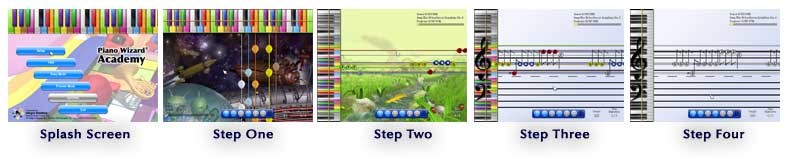
That is the problem Piano Wizard was designed to address.
It combines a real MIDI keyboard, interactive feedback, visual learning, game-based repetition, and a progression toward reading conventional music notation.
For a broader comparison of today's piano learning methods, see our updated guide. You can also compare piano learning methods side by side, including private lessons, video instruction, apps, and interactive software.