

If you homeschool your children, you already know the challenge. There are only so many hours in the day, and every new subject can feel like one more thing competing for time.
Music often gets pushed aside for exactly that reason.
But adding piano to your homeschool does not have to mean driving to weekly lessons, becoming your child's music teacher, or adding another complicated curriculum to your schedule.
With the right approach, a homeschool piano curriculum can fit naturally into your week, even if you have never played piano yourself.
Here is how to make it work.
Why Add Piano to Your Homeschool?
Piano is one of the easiest instruments for children to begin exploring because the notes are laid out visually and a child can produce a clear sound immediately by pressing a key.
Learning piano can also help children practice skills that extend beyond music, including:
- Concentration
- Hand-eye coordination
- Fine motor control
- Listening
- Pattern recognition
- Rhythm and counting
- Creativity
- Persistence
But there is another benefit that matters just as much.
Children get to make something.
Instead of only reading, watching, or answering questions, they can sit at the keyboard and hear themselves produce actual music.
That can make piano a welcome change of pace during the homeschool day.
Music education has also been associated with a range of cognitive, social, and developmental benefits. The NAMM Foundation provides a useful overview of research into how children benefit from learning music.
What Should a Homeschool Piano Curriculum Include?
A good homeschool piano program should work with the flexibility that homeschooling provides rather than trying to recreate a traditional weekly lesson at home.
Look for a method that allows children to:
- Learn at their own pace
- Practice in short sessions
- Work independently when appropriate
- See clear progress
- Learn without requiring the parent to already understand music
- Gradually develop real music-reading skills
For many homeschool families, flexibility is one of the biggest advantages.
If Tuesday becomes hectic, piano can happen Wednesday.
If your child wants to spend extra time playing one day, there is no reason to stop because a thirty-minute lesson has ended.
That makes piano easier to fit around the rest of your curriculum.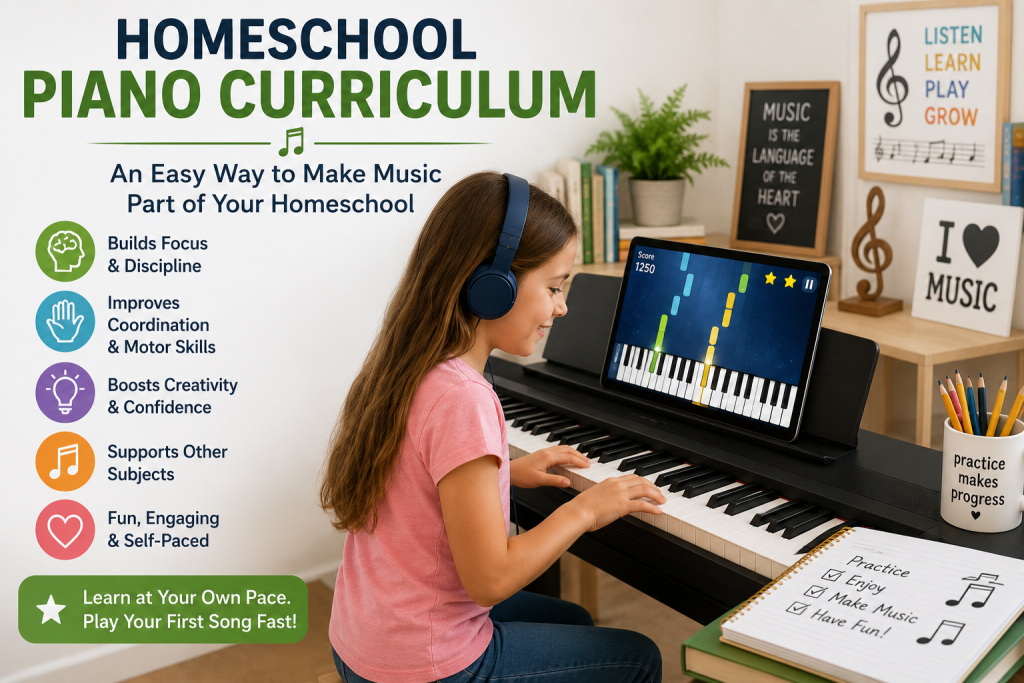
Traditional Lessons vs. a Homeschool Approach
Traditional private lessons can be excellent, especially with the right teacher.
But they are not the only way to begin.
A traditional lesson schedule usually means a set appointment each week, travel time, lesson fees, and practice assignments between sessions.
A homeschool piano curriculum can work differently.
Your child can practice at home, repeat activities as often as needed, move quickly through material that comes easily, and spend more time on anything that requires extra attention.
For some families, that independence makes music much easier to maintain consistently.
And consistency matters far more than trying to squeeze everything into one long weekly session.
1. Choose a Method Your Child Will Actually Use
The best piano curriculum is not necessarily the one with the thickest workbook or the most theory lessons.
It is the one your child will keep using.
Young beginners often respond well when they can connect what they see on the screen with what they are playing on the keyboard.
That is the idea behind Piano Wizard Academy.
Instead of beginning with traditional notation alone, Piano Wizard starts with an interactive, game-based approach. Children connect visual cues with the correct piano keys and begin playing songs early in the process.
As they progress, those visual cues gradually transition toward standard music notation.
The goal is not to replace music reading.
The goal is to give children a more intuitive path toward it.
2. Keep Practice Short and Consistent
You do not need an hour of piano every day.
For many beginners, shorter sessions work better.
A simple starting routine might be:
- 15 to 20 minutes
- Three to five days per week
- At roughly the same point in your homeschool day
You might put piano after math, before lunch, or at the end of the school day as something your child looks forward to.
The exact time matters less than making it part of the routine.
Short, regular practice gives children repeated exposure without making piano feel like another long assignment.
3. Let Your Child See Progress
Children are much more motivated when they can see themselves improving.
That does not require elaborate grading.
You can track progress with:
- A simple practice calendar
- A list of completed songs
- Short video recordings
- A monthly family performance
- Small goals for each week
Video can be especially useful.
Record your child playing a song today, then record the same song again a few weeks later.
The difference may be more obvious to them than anything you could say.
That gives them evidence that practice is working.
4. Connect Piano With Other Homeschool Subjects
Music does not have to be isolated from the rest of your homeschool curriculum.
Piano can connect naturally with other subjects.
Math
Rhythm involves counting, patterns, fractions, and timing.
History
Study composers, musical styles, and the historical periods in which different music was created.
Geography
Explore music from different countries and cultures.
Science
Use musical instruments to discuss sound waves, vibration, pitch, and acoustics.
Language Arts
Listen to songs, discuss lyrics, or have children describe the mood and story of a piece of music.
These connections can make music feel like part of your homeschool rather than an extra subject added on top of everything else.
5. You Do Not Need to Know Piano Yourself
This is one of the biggest concerns homeschool parents have.
How can you teach piano if you do not play?
In many cases, you do not need to.
A well-designed homeschool piano curriculum should provide enough instruction that the parent becomes a facilitator rather than the music teacher.
Your role can be much simpler:
Help establish a routine.
Encourage practice.
Celebrate progress.
Make sure the keyboard is available.
Ask your child to play something for you.
That is often enough.
With Piano Wizard, the instructional process is built into the program, so parents do not need to explain every note, rhythm, or musical concept themselves.
6. Choose a Keyboard That Makes Practice Easy
You do not need a concert grand piano to begin.
A digital keyboard is often a practical choice for homeschooling because it takes up less space, can be used with headphones, and does not require tuning.
For beginners, a keyboard with at least 61 full-size keys can provide plenty of room to get started.
If your child progresses and becomes more serious about piano, you can always upgrade later.
The important thing at the beginning is having an instrument that is easy to access.
If the keyboard is buried in a closet, practice becomes a project.
If it is sitting somewhere your child can easily use it, playing becomes much more likely.
7. Make Piano Part of Family Life
Music becomes more meaningful when children have someone to play for.
That does not mean formal recitals.
Ask your child to play a song after dinner.
Let grandparents listen over a video call.
Have siblings learn something together.
Record a performance and save it.
Invite another homeschool family over for a small music afternoon.
These experiences give children a reason to practice and help turn piano from another school subject into something they can actually share.
A Simple Homeschool Piano Setup
You do not need much to get started.
A basic setup can include:
- A digital piano or keyboard
- A comfortable bench or chair
- Headphones for quiet practice
- A laptop or tablet if your curriculum uses interactive lessons
- A simple practice schedule
- A piano program designed for independent learning
That is enough to make piano a regular part of your homeschool.
What Makes Piano Wizard Different?
Piano Wizard was created around a simple idea:
Children are more likely to keep learning when they experience the reward of making music early.
Instead of requiring beginners to master traditional notation before they can play recognizable songs, Piano Wizard lets them begin by playing in an interactive environment.
As their skills develop, the system gradually moves them toward traditional notation and keyboard playing.
For homeschool families, that means children can work at their own pace while parents provide encouragement rather than formal instruction.
Ready to Add Piano to Your Homeschool?
You do not need to completely reorganize your homeschool schedule.
You do not need to become a piano teacher.
And your child does not need to spend months studying theory before playing music.
Start with a keyboard.
Set aside a few minutes several days a week.
Give your child a method that makes the first steps enjoyable.
Then let progress build from there.
Explore Piano Wizard Academy and see how the Piano Wizard approach can become part of your homeschool piano curriculum.
Want to add music beyond piano? Read our guide to 6 Easy Ways to Build Music Into Your Homeschool Curriculum.