
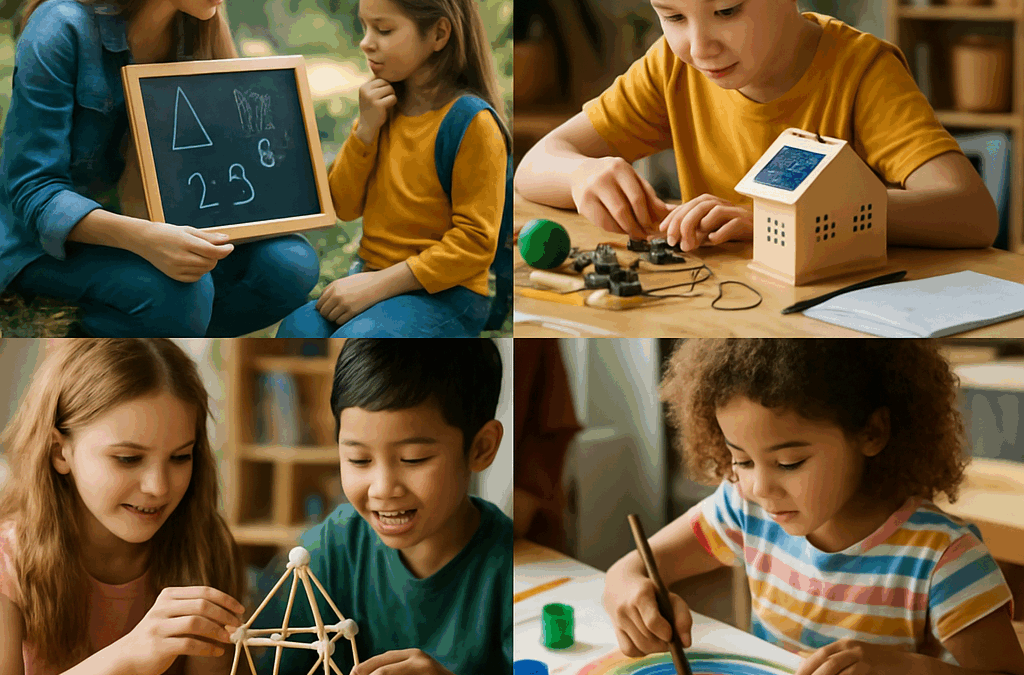
A non-traditional homeschool curriculum can give families something conventional programs sometimes struggle to provide: flexibility to build learning around the child instead of forcing every child through the same path.
For some families, that means more hands-on projects. For others, it means spending more time outdoors, integrating music and art into academic subjects, following a child's interests, or using technology more creatively.
If a traditional workbook-heavy approach is not working for your family, these five homeschool curriculum ideas offer different ways to make learning more active, flexible, and engaging.
What Is a Non Traditional Homeschool Curriculum?
A homeschool curriculum is simply the structure you use to guide learning at home. It can include books, lessons, activities, projects, online programs, field trips, music, experiments, and almost anything else that helps a child learn.
A non-traditional homeschool curriculum moves beyond relying primarily on textbooks, worksheets, and conventional classroom-style instruction.
That does not mean abandoning structure.
It means choosing a structure that better fits the learner.
Families may explore non-traditional approaches because they want:
- More hands-on learning
- Greater flexibility in pacing
- More creativity
- Interest-led exploration
- More opportunities for real-world learning
- A better fit for a child's individual learning style
The right approach will vary from one family to another. Some parents adopt an entire alternative method, while others borrow the parts that work and combine them with a more traditional curriculum.
1. Montessori-Inspired Homeschooling
Montessori education is built around independence, hands-on exploration, and allowing children to become active participants in their own learning.
You do not need to recreate a formal Montessori classroom at home to borrow useful ideas from the method.
he American Montessori Society provides a useful overview of Montessori principles and how child-centered, hands-on learning works.
Let Children Do More for Themselves
One of the central ideas is that children develop confidence by doing meaningful work independently.
At home, this can mean providing materials at an accessible level and allowing children to choose from several appropriate activities instead of directing every minute of the school day.
Use Hands-On Materials
Montessori-inspired learning often uses physical objects to make abstract concepts easier to understand.
Examples might include:
- Counting objects for mathematics
- Maps and globes for geography
- Letter tiles for language
- Measuring ingredients while cooking
- Sorting and classification activities
- Nature collections
Create an Inviting Learning Environment
A prepared environment makes it easy for children to see what learning materials are available and begin using them without waiting for an adult to organize everything.
Simple shelves, clearly labeled supplies, books, art materials, manipulatives, and puzzles can turn part of your home into a space where exploration happens naturally.
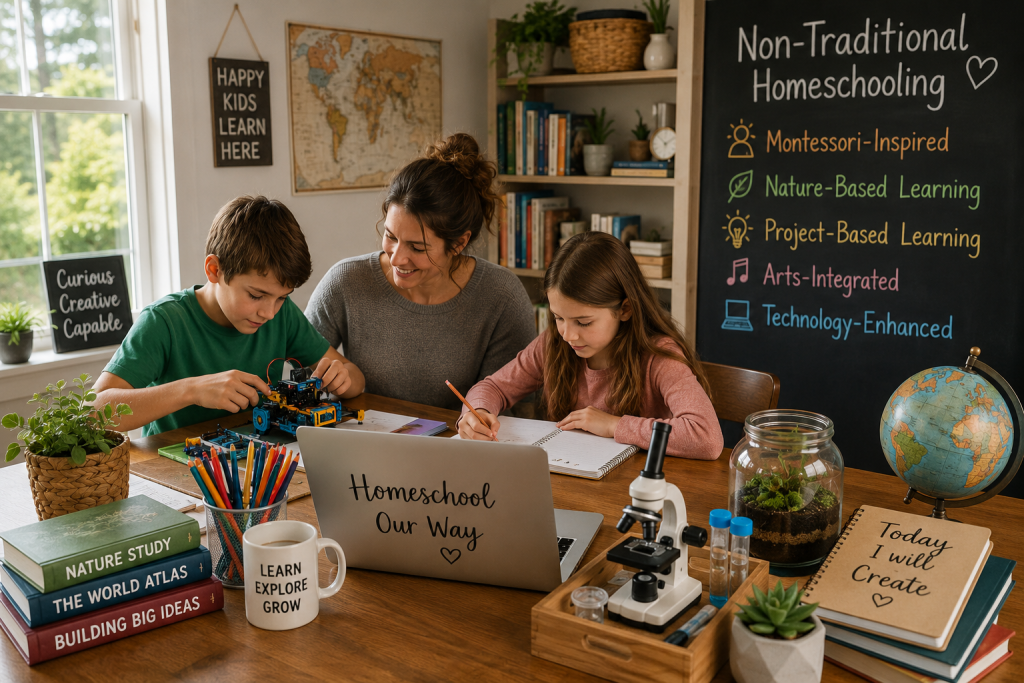
2. Nature-Based Homeschool Learning
A fun homeschool curriculum does not have to happen entirely around a kitchen table.
Nature-based homeschooling uses the outdoors as part of the learning environment.
A walk through a park can become biology, geography, art, writing, or environmental science depending on what you choose to explore.
Turn Observation Into Learning
Encourage children to notice what is around them.
Ask questions:
- What plants grow here?
- Why are certain insects found in one area but not another?
- How does the environment change through the seasons?
- What kinds of birds visit your neighborhood?
Children can record observations in a notebook, take photographs, draw what they see, or research questions when they return home.
Try Simple Outdoor Projects
Nature-based homeschool activities can include:
- Starting a small garden
- Keeping a weather journal
- Identifying trees and plants
- Creating a backyard wildlife log
- Collecting and classifying leaves
- Drawing landscapes
- Studying local ecosystems
These activities make academic subjects tangible because the child is learning from something they can actually see, touch, measure, and investigate.
3. Project-Based Learning
Project-based learning turns the usual order of education around.
Instead of teaching a collection of facts first and assigning a project afterward, students begin with an interesting question, problem, or goal.
The learning happens while they work toward the answer.
Combine Several Subjects Into One Project
Suppose a child decides to build a small vegetable garden.
That single project can involve:
- Science: plant growth, soil, insects, weather
- Math: measurements, spacing, area, budgeting
- Writing: keeping a garden journal
- Research: comparing plants and growing conditions
- Art: designing signs or drawing observations
Instead of subjects existing in separate boxes, children see how knowledge works together.
Other Project-Based Homeschool Ideas
- Build a birdhouse and study local birds
- Create a family newspaper
- Design a model city
- Produce a short documentary
- Plan a pretend business
- Research another country and prepare a meal from its culture
- Organize a neighborhood service project
Project-based learning can be especially useful for creative learners who become more engaged when there is a real purpose behind what they are studying.
4. Arts-Integrated Homeschool Curriculum
For creative children, art and music do not have to be extras that happen after the "real" schoolwork is finished.
They can become part of the learning itself.
Use Music Across Subjects
Music naturally connects with many academic areas.
- Math: counting, rhythm, patterns, fractions, timing
- History: composers, musical eras, cultural movements
- Geography: musical traditions from around the world
- Science: vibration, frequency, acoustics, sound waves
- Language: lyrics, storytelling, rhythm, poetry
If you want to make piano a regular part of your homeschool, see our guide to building a homeschool piano curriculum that fits naturally into the school week.
Turn Lessons Into Creative Projects
Instead of asking children only to read about a historical period, let them create something from it.
They might:
- Listen to music from the period
- Create artwork inspired by it
- Write a short play
- Design costumes
- Compose a simple song
- Create a visual timeline
This kind of creative homeschool curriculum can be especially effective for children who learn by making, performing, or experimenting.
5. Technology-Enhanced Homeschool Learning
Technology can be more than a replacement for a textbook.
Used thoughtfully, it can give homeschoolers access to interactive lessons, simulations, virtual museums, educational games, video demonstrations, music programs, and subjects parents may not feel comfortable teaching themselves.
Use Technology for Things It Does Well
Technology is especially useful when it adds something that would be difficult to reproduce with a book.
For example:
- Interactive science simulations
- Virtual museum tours
- Language pronunciation practice
- Educational games
- Video demonstrations
- Interactive music instruction
- Self-paced courses
Combine Screen Learning With Real-World Activities
The most useful technology-enhanced programs do not necessarily keep children on a screen all day.
An online science lesson can lead to a real experiment.
A geography video can lead to map work.
A music program can lead directly to playing a real keyboard.
The technology becomes a tool rather than the entire curriculum.
How to Choose the Right Non-Traditional Homeschool Curriculum
There is no single best homeschool curriculum for every child.
The real advantage of homeschooling is that you can adjust the method instead of assuming the child must adjust to the method.
When evaluating an alternative approach, consider:
Your Child's Interests
What subjects naturally attract their attention?
A child fascinated by animals may respond beautifully to nature-based learning. A child who constantly builds things may thrive with projects. A musical child may benefit from an arts-integrated approach.
How Your Child Learns
Some children enjoy reading and discussion.
Others need to move, build, experiment, draw, listen, or manipulate physical objects before an idea really makes sense.
Your Family's Schedule
A curriculum that looks wonderful on paper is not useful if it requires a schedule your family cannot maintain.
Look for something that fits realistically into your week.
Your Budget
Non-traditional does not necessarily mean expensive.
Libraries, parks, community resources, inexpensive materials, free online resources, and ordinary household items can support an enormous amount of learning.
Whether It Is Actually Working
Give yourself permission to change course.
If something is creating constant frustration, ask whether the problem is the child or simply the method.
Homeschooling gives you the freedom to adjust.
Build a Homeschool Curriculum Around the Learner
A non-traditional homeschool curriculum does not have to mean throwing out everything traditional.
You might use a conventional math program while doing project-based science.
You might combine structured reading lessons with nature study.
You might use technology for certain subjects while keeping others completely hands-on.
And you might make music, art, gardening, building, cooking, or field trips part of the curriculum instead of treating them as optional extras.
The goal is not to be unconventional for its own sake.
The goal is to find an approach that makes learning work better for your child.
If music is one of the areas you would like to expand, start with our guide to creating a homeschool piano curriculum and see how easily piano can become part of learning at home.