

Perfect. We'll build this exactly like we did the beginner article.
How to Read Sheet Music Basics
Learning how to read sheet music may seem overwhelming when you first look at a page filled with lines, dots, and unfamiliar symbols. The good news is that sheet music follows a simple system. Once you understand a few basic concepts, you'll begin recognizing notes, rhythms, and patterns much more quickly than you might expect.
Whether you're learning piano yourself or helping your child begin their musical journey, understanding the basics of reading sheet music opens the door to thousands of songs and a lifetime of musical enjoyment.
In this guide, you'll learn how to read sheet music basics, understand piano notes, recognize the grand staff, and develop the confidence to begin playing music one note at a time.
What Is Sheet Music?
Before learning individual notes, it helps to understand what sheet music actually is.
Think of sheet music as a written language for music. Just as books use letters and words to tell a story, sheet music uses notes, symbols, and rhythms to tell musicians exactly what to play and when to play it.
Every symbol on the page has a purpose. Some tell you which key to press, others tell you how long to hold the note, how loudly to play, or even how much feeling to put into the music.
The good news is that you don't have to learn everything at once. Most beginners only need a handful of concepts before they can begin playing simple songs.
Quick Tip
Don't try to memorize every musical symbol before you start playing. Learn one concept at a time, then immediately apply it at the keyboard. That's the fastest way to build confidence.
Music notation has been used for centuries to preserve and share musical ideas. Today, standard music notation is the universal language musicians use around the world. If you'd like to explore the history and basics of music notation, the Library of Congress guide to reading music notation provides an excellent introduction.
Understanding the Grand Staff
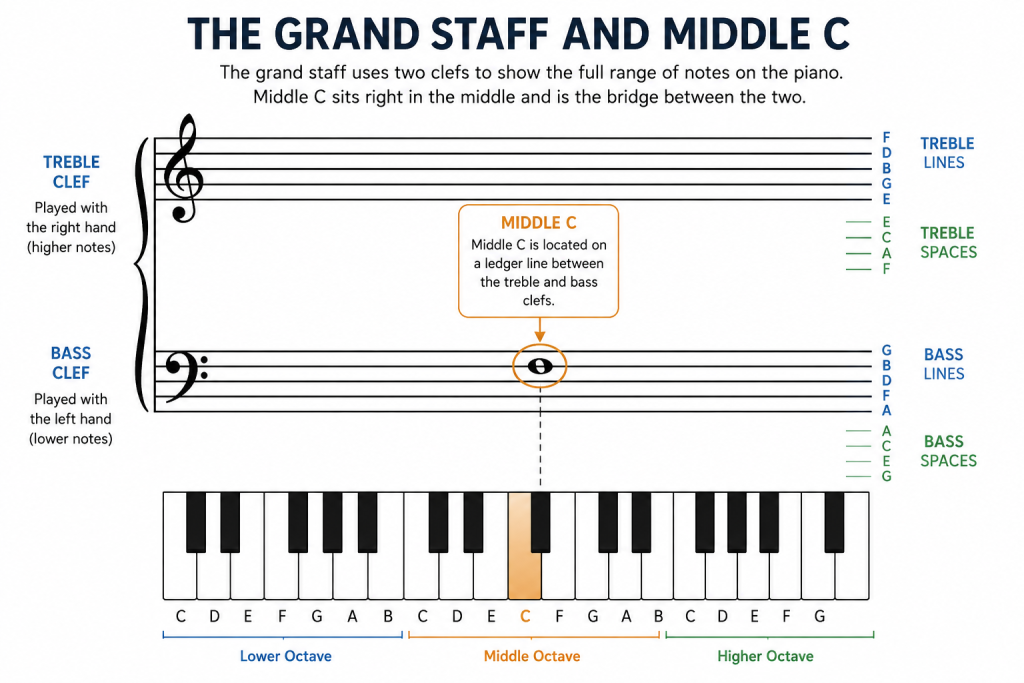
If you've ever looked at piano music, you've probably noticed that it contains two groups of five horizontal lines connected together.
This is called the Grand Staff, and it's the foundation of almost all piano music.
The upper staff uses the Treble Clef, which is generally played with the right hand and contains higher-pitched notes.
The lower staff uses the Bass Clef, which is usually played with the left hand and contains lower-pitched notes.
Between them sits one of the most important notes on the piano:
Middle C
Middle C acts as the bridge between the Treble and Bass Clefs.
Finding Middle C on your keyboard gives you an excellent starting point because many beginner songs are written around it. Once you know where Middle C is located, the surrounding notes become much easier to identify.
Piano Note Names Made Simple
One of the first things every beginner should learn is that the piano uses only seven musical letters.
Unlike the regular alphabet, music repeats the same seven note names over and over again:
A – B – C – D – E – F – G
After G, the pattern starts over at A.
That's it. Every song you'll ever play is built from these seven note names.
Finding Notes on the Piano
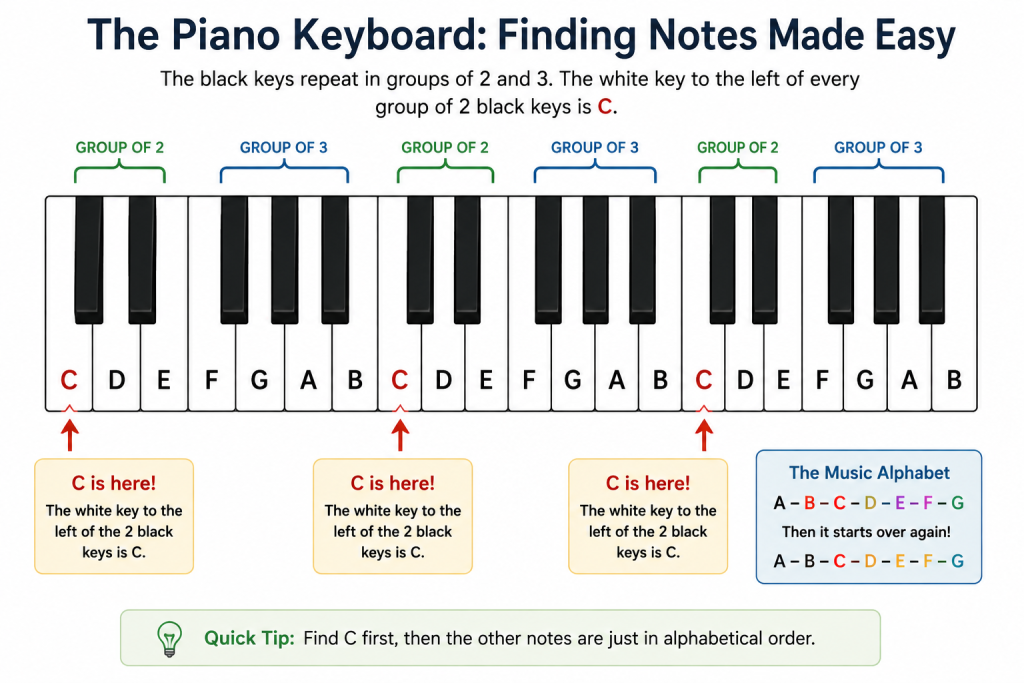
The easiest way to locate notes is by using the groups of black keys.
Look at your keyboard and you'll notice a repeating pattern:
- Two black keys
- Three black keys
- Two black keys
- Three black keys
This pattern repeats across the entire keyboard.
The white key immediately to the left of every group of two black keys is C.
Once you've found C, the remaining notes simply follow the alphabet:
C – D – E – F – G – A – B
Then the pattern repeats again.
Quick Tip
Instead of memorizing all 88 keys, learn to recognize the repeating pattern of the black keys. It allows you to find every C on the keyboard in seconds.
Excellent. Now we move into one of the most searched topics.
Reading the Treble Clef
The Treble Clef, sometimes called the G Clef, is the upper half of the Grand Staff and is usually played with your right hand. Most melodies begin here, making it one of the first skills every new pianist should learn.
At first, the notes may look confusing, but you'll quickly begin recognizing patterns instead of individual symbols.
Reading the Lines
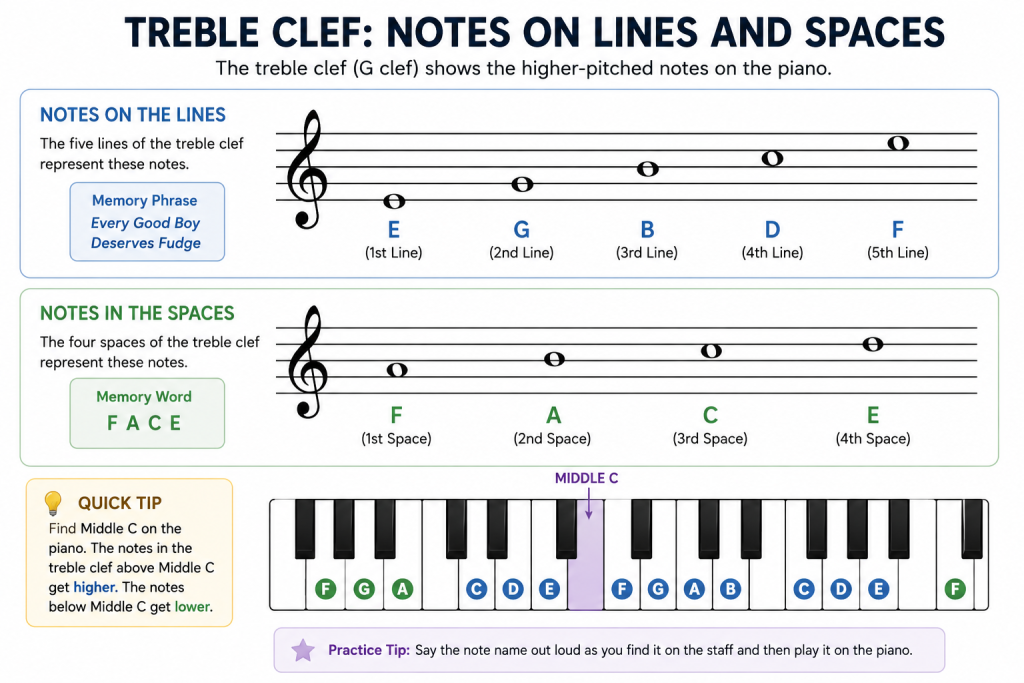
The five lines of the Treble Clef represent these notes:
E – G – B – D – F
Many students remember them with the phrase:
Every Good Boy Deserves Fudge
Feel free to create your own phrase if it's easier to remember. The goal is simply to recognize the notes without having to think about them.
Reading the Spaces
The four spaces spell an easy word:
F – A – C – E
Together they spell:
FACE
Because it's already a real word, most beginners memorize the spaces very quickly.
Tips for Reading the Treble Clef Faster
Instead of trying to identify every note individually, begin looking for familiar patterns.
For example:
- Notes moving up usually move to the next line or space.
- Notes moving down usually move to the previous line or space.
- Repeated notes stay in the same position.
- Small jumps often become recognizable after a little practice.
Professional pianists don't read one note at a time. They recognize groups of notes and common musical patterns, much like experienced readers recognize entire words instead of sounding out every letter.
Piano Wizard Tip
Try to keep your eyes on the sheet music instead of constantly looking down at your hands. The more you trust your fingers to find the correct keys, the faster your reading skills will improve.
Reading the Bass Clef
The Bass Clef, sometimes called the F Clef, is the lower half of the Grand Staff and is usually played with your left hand. While the Treble Clef carries many of the melodies, the Bass Clef provides the lower notes that give music depth, harmony, and rhythm.
Many beginners find the Bass Clef slightly more challenging at first because it uses different note positions than the Treble Clef. The good news is that the same patterns repeat, and with a little practice you'll begin recognizing the notes just as quickly.
Reading the Lines
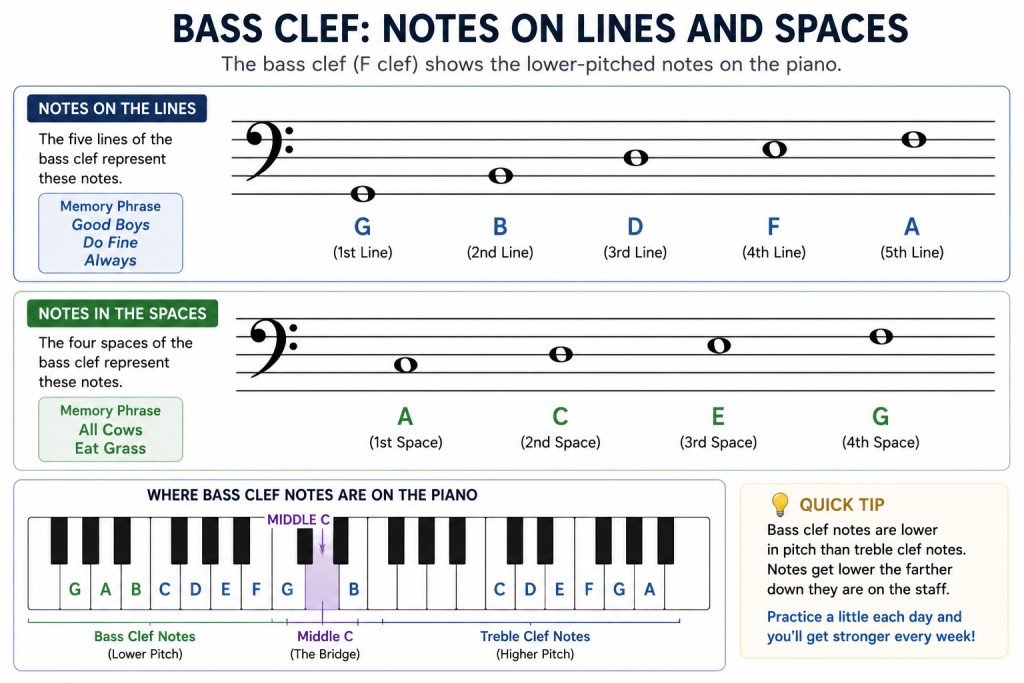
The five lines of the Bass Clef represent these notes:
G – B – D – F – A
Many students remember them with the phrase:
Good Boys Do Fine Always
Choose any memory phrase that helps you remember the order.
Reading the Spaces
The four spaces spell:
A – C – E – G
A popular way to remember them is:
All Cows Eat Grass
Like the Treble Clef, you'll eventually stop relying on memory phrases as your note recognition becomes automatic.
Connecting Both Clefs
One of the biggest breakthroughs for new pianists comes when they realize the Treble and Bass Clefs aren't two separate systems. They work together to cover the full range of the piano.
Think of the Grand Staff as one large map:
- Treble Clef = Higher notes (usually the right hand)
- Bass Clef = Lower notes (usually the left hand)
- Middle C = The bridge connecting both staffs
Once you understand this relationship, reading piano music becomes much easier because you begin seeing the keyboard as one continuous instrument rather than two separate parts.
Piano Wizard Tip
Don't try to memorize every note in one practice session. Learn a few notes well, play simple songs using those notes, then gradually add more. Small daily victories build lasting confidence.
Understanding Rhythm and Time Signatures
Finding the correct notes is only half of learning to read sheet music.
The other half is rhythm.
Rhythm tells you how long to hold each note and when to play it. Without rhythm, even the correct notes won't sound like the song.
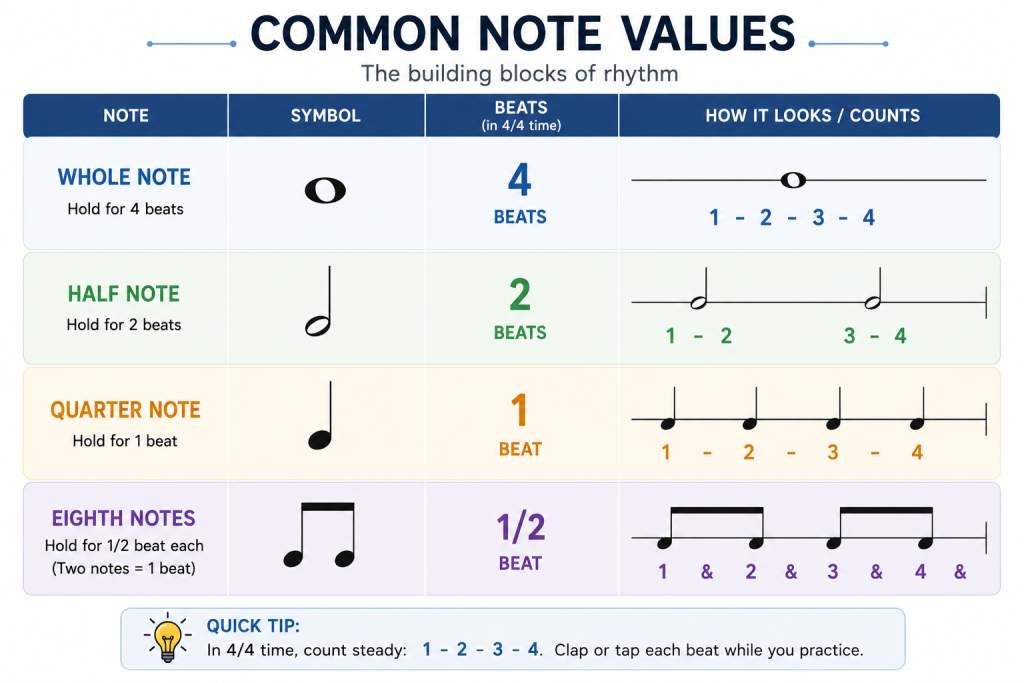
Note Values
Every note has a time value.
The four most common note values beginners should learn are:
- Whole Note – Hold for 4 beats
- Half Note – Hold for 2 beats
- Quarter Note – Hold for 1 beat
- Eighth Notes – Two notes played within 1 beat
Understanding Time Signatures
At the beginning of most pieces of sheet music, you'll see two numbers that look like a fraction.
These numbers are called the time signature, and they tell you how the music is organized.
The top number tells you how many beats are in each measure.
The bottom number tells you which type of note receives one beat.
Think of the time signature as the musical "speed limit sign." Before you begin playing, it tells you how to count the music.
The Most Common Time Signature: 4/4
Most beginner piano music is written in 4/4 time.
This means:
- There are 4 beats in every measure.
- A quarter note receives 1 beat.
When counting 4/4 time, simply count:
1 – 2 – 3 – 4
Then begin again for the next measure.
You'll find 4/4 time in countless children's songs, pop songs, hymns, and beginner piano books.
(Insert simple 4/4 time signature diagram.)
Other Common Time Signatures
As your piano skills improve, you'll encounter other time signatures.
3/4 Time
- 3 beats per measure
- Quarter note receives one beat
Count:
1 – 2 – 3
This is commonly heard in waltzes.
2/4 Time
- 2 beats per measure
- Quarter note receives one beat
Count:
1 – 2
This creates a steady marching feel.
6/8 Time
As you become a more advanced player, you'll also encounter 6/8 time.
Instead of feeling four steady beats, 6/8 is usually counted in two larger groups:
1 2 3 4 5 6
It creates a smooth, flowing rhythm often heard in ballads and traditional folk music.
Don't worry about mastering 6/8 right away. Most beginners start with 4/4 before moving on to other time signatures.
Piano Wizard Tip
Before you play a new song, always check the time signature first. It tells you how to count the music and helps you keep a steady rhythm from the very first measure.
Landmark Notes: The Secret to Reading Music Faster
Many beginners believe they have to memorize every note on the staff before they can read sheet music.
Fortunately, that's not true.
Experienced pianists use landmark notes to quickly identify where they are on the page. Once you know a few important reference points, the surrounding notes become much easier to recognize.
Start with Middle C
The first landmark every pianist should know is Middle C.
Middle C sits between the Treble and Bass Clefs and acts as the bridge between the two staffs. Because it's located near the center of the keyboard, it's one of the easiest notes to find.
Many beginner songs begin on or near Middle C, making it an excellent starting point for learning to read music.
Learn a Few Reference Notes
After Middle C, focus on recognizing a handful of other notes instead of trying to memorize the entire staff.
Some helpful landmarks include:
- Treble G – Located on the second line of the Treble Clef.
- Bass F – Located on the fourth line of the Bass Clef.
- Treble C – Found on the third space of the Treble Clef.
- Bass C – Found on the second space of the Bass Clef.
Once you recognize these reference notes, you can quickly identify nearby notes by simply moving up or down one line or one space.
Read by Patterns, Not Individual Notes
As your confidence grows, you'll begin noticing that music is full of repeating patterns.
Instead of identifying every note one at a time, your brain starts recognizing:
- Notes that move up or down step by step
- Small skips between notes
- Repeated notes
- Familiar chord shapes
This is exactly how experienced readers process written music. They don't read individual notes any more than you read a book one letter at a time.
Piano Wizard Tip
Don't aim to memorize every note immediately. Learn a few landmark notes first, then use them as reference points to identify the notes around them. You'll read music faster and with much less frustration.
Frequently Asked Questions About Reading Sheet Music
Is it difficult to learn how to read sheet music?
Not at all. While sheet music may look intimidating at first, it follows a logical system. Once you understand the staff, note names, and a few basic symbols, you'll begin recognizing patterns instead of memorizing every note. Like learning to read words, it becomes easier with regular practice.
Can I learn piano without reading sheet music?
Yes. Many people begin by learning songs by ear, watching videos, or using visual learning methods. However, learning to read sheet music opens the door to thousands of songs, helps you become a more independent musician, and makes learning new pieces much easier.
How long does it take to learn to read sheet music?
Most beginners can understand the basics within a few weeks of consistent practice. Becoming a confident music reader takes longer, but even practicing for 10 to 15 minutes each day can lead to steady improvement.
Do I need to memorize every note?
No. Good music readers don't rely on memorization alone. They recognize landmark notes, intervals, and familiar patterns. As you gain experience, reading music becomes much more natural.
What's the best way to improve?
Practice a little every day. Read simple songs, identify landmark notes, and play slowly enough to avoid mistakes. Consistency is far more important than practicing for long periods only once in a while.
Learn Piano the Easy Way
Learning how to read sheet music is an important milestone, but it doesn't have to be frustrating.
At Piano Wizard Academy, we've spent more than 30 years helping beginners discover that learning piano can be enjoyable, rewarding, and easier than they ever imagined.
Our unique step-by-step learning system helps students connect what they see on the page with what they play on the keyboard. Instead of relying on endless drills and memorization, you'll build confidence through simple lessons, recognizable patterns, and songs you can actually enjoy playing.
Whether you're learning on your own, teaching your child, or returning to piano after many years away, Piano Wizard Academy provides the tools and guidance to help you succeed.
Ready to take the next step?
- Explore our Free Beginner Piano Lessons
- Read inspiring Student Success Stories
- Discover the complete Piano Wizard Learning System
(Insert three internal links here.)
Final Thoughts
Learning how to read sheet music isn't about memorizing hundreds of notes or mastering music theory overnight. It's about understanding a simple system and building your skills one step at a time.
Every accomplished pianist began exactly where you are now, looking at a page of unfamiliar symbols and wondering how they all fit together. With consistent practice, those symbols gradually become familiar notes, recognizable patterns, and eventually, beautiful music.
As your confidence grows, you'll move beyond identifying individual notes and begin reading entire musical phrases almost effortlessly.
Most importantly, enjoy the journey. Every song you learn strengthens your reading skills and brings you one step closer to becoming the pianist you want to be.
What's Next?
Now that you've learned the fundamentals of reading sheet music, your next challenge is avoiding the mistakes that slow many beginners down.
In our next guide, 10 Common Mistakes Beginners Make When Reading Sheet Music, you'll discover the habits that make learning harder than it needs to be and the simple techniques that help you read music faster and with greater confidence.