
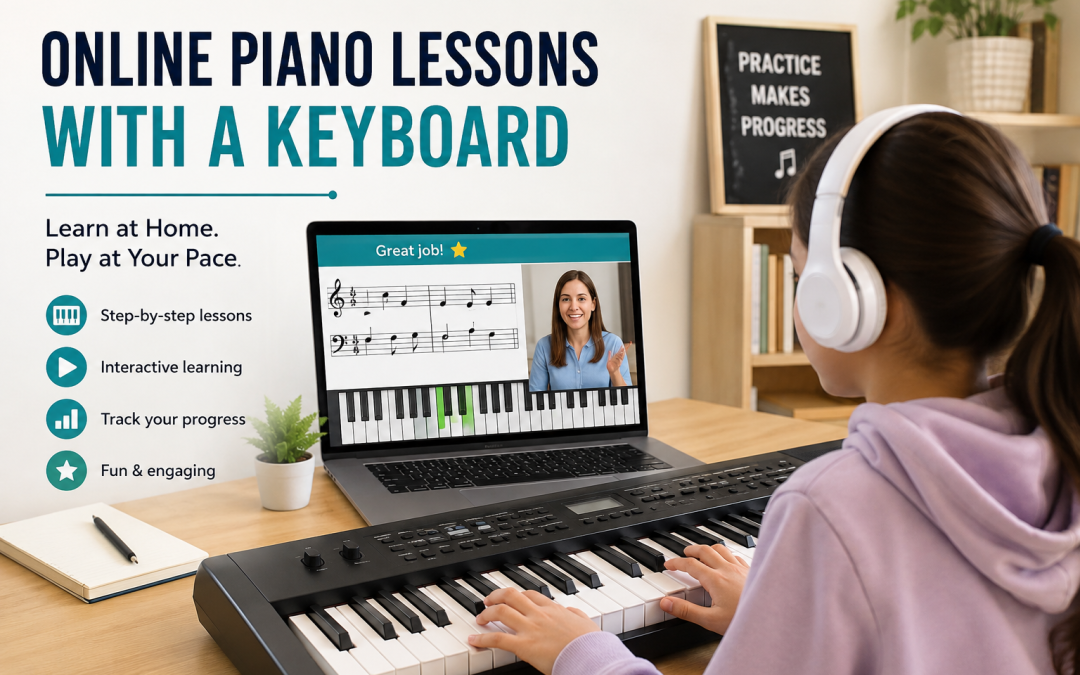
Choosing the right online piano lessons with keyboard can feel overwhelming.. There are live teachers, video courses, apps, games, subscriptions, and self-paced programs, all promising to help you or your child learn piano.
The best choice depends on how you want to learn.
Some students do well with a live teacher and a fixed schedule. Others need more flexibility. Younger students may benefit from visual and interactive lessons, while adult beginners may prefer a structured program they can follow at their own pace.
The key is finding a method that keeps the student engaged while still building real piano skills.
Here is what to look for.
Start With Your Goals
Before comparing programs, decide what you actually want from piano lessons.
Are you looking for:
- A beginner-friendly introduction to piano?
- A structured course for your child?
- A self-paced program you can use at home?
- A way to learn songs quickly?
- A path toward reading standard music notation?
- A flexible alternative to weekly private lessons?
Your goal should determine the type of program you choose.
A child who needs motivation may benefit from an interactive approach. An adult beginner may prefer a clear sequence of lessons. A student who already plays may need more traditional technique and repertoire.
The best online piano program is the one that matches the learner.
Make Sure the Program Works With a Real Keyboard
This sounds obvious, but not every piano-learning platform is built around actually playing a keyboard.
Some programs rely heavily on videos, quizzes, or touchscreen exercises.
Those can be useful, but if your goal is to learn piano, the student should be spending real time at the keys.
Look for a program that encourages the learner to connect what they see and hear with what they physically play.
That connection is especially important for beginners.
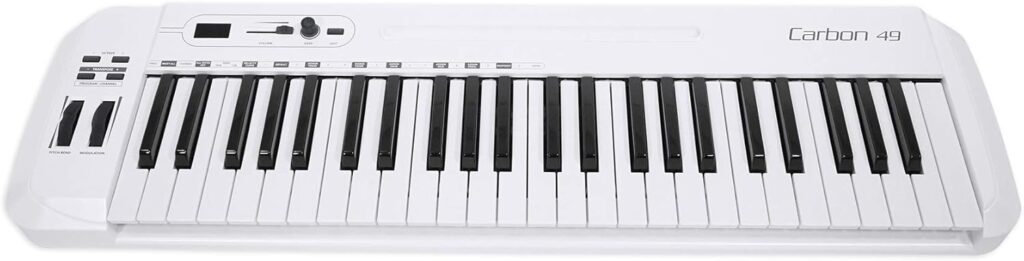 What Kind of Keyboard Do You Need?
You do not need an expensive acoustic piano to begin.
A digital keyboard can work very well for online piano lessons because it is affordable, compact, and easy to use with headphones.
For beginners, a keyboard with full-size keys is usually the best choice.
A 61-key keyboard can provide plenty of room for early learning, while an 88-key digital piano gives the student the full range of a traditional piano.
If the program uses MIDI or USB connectivity, make sure your keyboard can connect to the device you plan to use.
The simpler the setup, the easier it is to practice consistently.
Not sure whether to start with 61 or 88 keys? Yamaha offers a useful beginner's guide to choosing between a 61-key keyboard and an 88-key piano.

What to Look for in Online Piano Lessons With Keyboard
Compare Live Lessons and Self-Paced Piano Programs
There are two main ways to learn piano online.
Live Online Piano Lessons
Live lessons connect the student with a teacher through video.
This can be a good option for students who want:
- Personal feedback
- A set weekly schedule
- Direct interaction with an instructor
- Customized assignments
The disadvantage is that live lessons still require scheduling and usually cost more than self-paced programs.
Self-Paced Online Piano Lessons
Self-paced lessons let students learn whenever it fits their schedule.
This works especially well for families, homeschoolers, and adult beginners who do not want to plan around a weekly appointment.
Students can:
- Repeat lessons
- Slow down when needed
- Move faster when something comes easily
- Practice at any time
- Spend extra time on difficult sections
For many beginners, that flexibility makes it easier to stick with piano.
Look for a Clear Learning Path
A good online piano program should give the student a clear sense of what comes next.
Random video tutorials can be useful for learning individual songs, but they do not always provide a complete curriculum.
A structured program should gradually build skills such as:
- Keyboard orientation
- Rhythm
- Finger coordination
- Note recognition
- Music reading
- Hand independence
- Timing
- Repertoire
The student should know where they are, what they have completed, and what they are learning next.
That structure can be especially important for beginners who do not yet know what they need to practice.
Interactivity Can Make a Big Difference
One of the biggest advantages of modern online piano lessons is interactivity.
Instead of simply watching someone else play, students can respond to visual cues, receive immediate feedback, and interact directly with the lesson.
Interactive features can include:
- Note tracking
- Visual keyboard guides
- Progress indicators
- Games and challenges
- Instant feedback
- Repetition of difficult sections
This can make practice more engaging, especially for younger students.
It can also help beginners understand the relationship between what they see on the screen and what they play on the keyboard.
Game-Based Learning Can Help Beginners Get Started
Traditional piano instruction often begins with notation, theory, and exercises before students play much recognizable music.
That works for some students.
Others lose interest before they experience the reward of actually playing.
Game-based piano learning reverses that order.
Students begin by interacting with the keyboard and making music early, then gradually develop the skills needed for more traditional piano playing.
That is the approach used by Piano Wizard Academy.
Piano Wizard begins with a visual, game-like system that helps students connect what they see with the correct keys.
As they progress, the visual system gradually transitions toward standard musical notation.
The goal is not to avoid reading music.
It is to make the transition easier.
Consider How Much Parent Involvement Is Required
For parents choosing online piano lessons for a child, this is an important question.
Some programs require a parent to explain concepts, manage every lesson, or sit beside the student during practice.
Others are designed for more independent learning.
If you do not play piano yourself, look for a program that provides enough guidance for the child to work through much of the material independently.
Your role can then be to:
- Encourage regular practice
- Help maintain a routine
- Celebrate progress
- Make sure the equipment is ready
- Listen when your child wants to perform
You do not necessarily need to become the piano teacher.
Make Sure Practice Is Easy to Fit Into Your Schedule
Consistency matters more than marathon practice sessions.
For beginners, short sessions several times a week can be more useful than one long session.
A simple schedule might be:
- 15 to 20 minutes
- Three to five days per week
- At a consistent point in the day
Online piano lessons work best when they make this routine easier rather than more complicated.
The student should be able to sit down, open the lesson, and start playing without a long setup process.
Check Device Compatibility
Before buying any program, make sure it works with the equipment you already have.
Check whether the program supports:
- Windows
- Mac
- Chromebook
- Tablets
- Mobile devices
- MIDI keyboards
- USB-connected keyboards
Also check whether the program requires an internet connection for every lesson or offers downloadable material.
Compatibility problems can quickly turn enthusiasm into frustration.
Look for Progress Tracking
Students are more motivated when they can see improvement.
Useful progress features might include:
- Completed lesson tracking
- Song lists
- Practice history
- Scores
- Levels
- Certificates
- Achievement badges
Parents can also create their own simple progress system.
Record a short video every few weeks or keep a list of songs the student has completed.
Visible progress can be one of the best motivators.
Read Reviews, But Look for Patterns
Reviews can be useful, but do not focus too heavily on one extremely positive or negative comment.
Look for repeated themes.
Do users consistently mention:
- Ease of use?
- Student engagement?
- Technical problems?
- Good customer support?
- Clear lessons?
- Progress?
- Difficulty canceling?
- Hidden costs?
Patterns are usually more useful than individual opinions.
If a free trial or sample lesson is available, use it.
The best way to judge an online piano program is to see how the student responds to it.
Compare Cost With Long-Term Value
Online piano lessons can vary widely in price.
Some are free.
Others charge monthly or annual subscription fees.
Live instruction usually costs more.
Do not judge a program only by the lowest price.
Consider what is included:
- Full curriculum
- Interactive lessons
- Software
- Video instruction
- Progress tracking
- Support
- Multiple student access
- Downloadable materials
A program that keeps a student practicing may offer more value than a cheaper option that gets abandoned after two weeks.
Why Piano Wizard Works Well With a Keyboard
Piano Wizard was designed to make the early stages of piano learning more engaging.
Instead of beginning with pages of notation, students start by playing.
They use visual cues to identify the correct keys and develop coordination through an interactive experience.
As they progress, those visual cues gradually change into standard music notation.
That makes Piano Wizard a natural fit for families looking for online piano lessons with a keyboard that combine structure, flexibility, and game-based learning.
Students can work at their own pace, repeat lessons as needed, and build skills without depending on a weekly appointment.
What to Look for Before You Choose
Before selecting an online piano program, ask these questions:
- Does it work with a real keyboard?
- Is it suitable for the student's age and skill level?
- Is the curriculum structured?
- Can the student learn at their own pace?
- Does it provide enough interaction to stay engaging?
- Does it gradually teach real piano skills?
- Is the software compatible with your equipment?
- Can you try it before committing?
- Is the cost reasonable for what is included?
If the answers fit your needs, you are probably looking at a strong option.
How to Play Piano for Beginners: A Complete Beginner’s Guide
The Best Online Piano Lessons Are the Ones You Keep Using
There is no single piano-learning method that is perfect for everyone.
Some students thrive with private teachers.
Others do better with a flexible online program.
Some need a traditional approach. Others respond better when learning feels more interactive.
The important thing is finding a method that gets the student to the keyboard regularly and keeps them progressing.
If the program is easy to use, engaging, structured, and built around actually playing the piano, it has a much better chance of becoming part of a lasting routine.
Explore Piano Wizard Academy and see how game-based piano learning can turn your keyboard into an interactive learning system.
If you are just getting started, you can also read our beginner's guide to learning piano.