
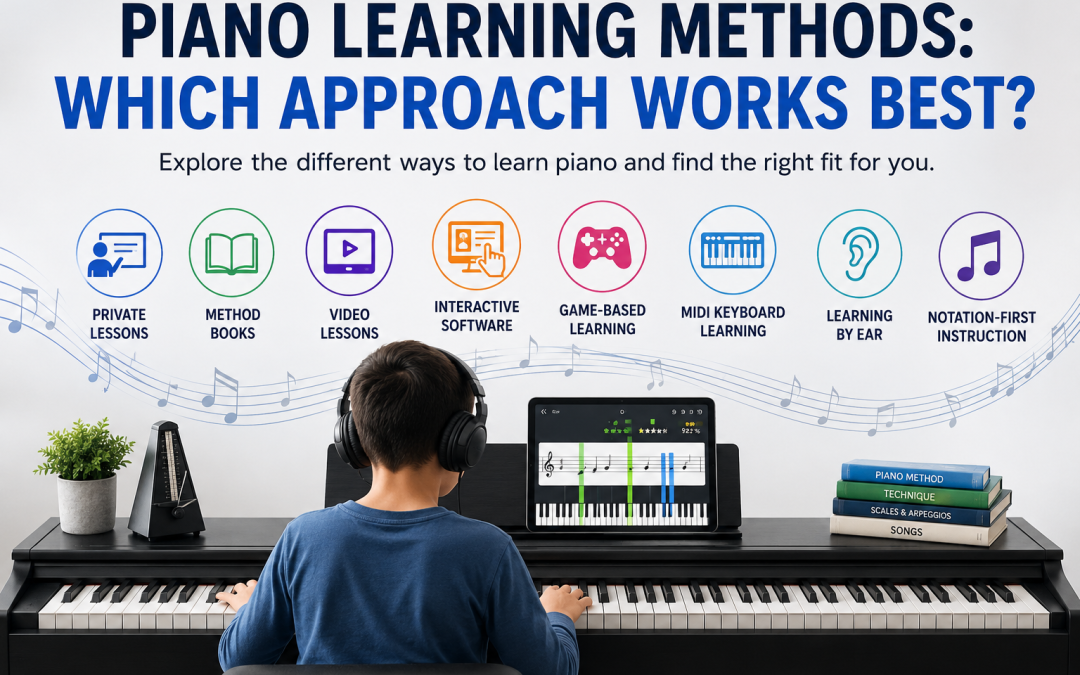
Piano learning methods vary widely.
Some students learn through traditional private lessons. Others prefer method books, video courses, interactive software, games, MIDI keyboards, or a combination of several approaches.
The challenge is not finding a way to learn piano. It is finding the approach that fits the student well enough that they actually keep playing.
Different methods emphasize different skills, different types of feedback, and different paths into reading music. In this guide, we will compare the major piano learning methods, explain where each approach works best, and help you decide which one may be the right fit for you or your child.
What Are the Main Piano Learning Methods?
Most piano instruction falls into one or more of these categories:
- Traditional private piano lessons
- Piano method books
- Video-based online lessons
- Interactive piano software
- Game-based piano learning
- MIDI keyboard learning
- Learning by ear
- Notation-first instruction
- Hybrid learning
None of these methods is automatically best for everyone.
The better question is:
Which method gets this particular student playing, progressing, and staying engaged?
1. Traditional Private Piano Lessons
Private lessons are one of the oldest and most familiar piano learning methods.
A teacher works directly with the student, usually once a week, and provides personalized instruction.
Advantages
- Direct personal feedback
- Individualized pacing
- Technique can be corrected immediately
- Teacher can adjust repertoire to the student
- Useful for advanced interpretation and performance
Limitations
- Can be expensive
- Requires scheduled lesson times
- Quality depends heavily on the teacher
- Practice between lessons is still largely independent
- Some beginners may find the traditional format slow or intimidating
Private lessons can be excellent, especially when the student and teacher are a good match. But they are not the only effective way to begin learning piano.
2. Piano Method Books
Method books organize piano instruction into a structured sequence of lessons, exercises, songs, and music-reading activities.
They are often used by private teachers, but independent learners can also use them at home.
Advantages
- Structured progression
- Clear written exercises
- Strong emphasis on notation
- Low cost compared with private lessons
- Easy to revisit earlier material
Limitations
- Little or no immediate feedback
- Can feel dry to some beginners
- Students may not know when they are making mistakes
- Young children may need substantial parent or teacher support
Method books work particularly well for students who enjoy structured study and are comfortable learning from printed material.
3. Video-Based Piano Lessons
Video lessons have become one of the most popular modern piano learning methods.
The student watches an instructor demonstrate a concept, song, or technique and then tries to reproduce it at the keyboard.
Advantages
- Lessons can be watched anytime
- Videos can be paused and replayed
- Students can watch a skilled player demonstrate technique
- Many courses are organized from beginner to advanced
Limitations
The biggest limitation is that most prerecorded video lessons cannot tell whether the student played something correctly.
The learning cycle is usually:
Watch → pause → imitate → evaluate yourself.
For some students, that works well. Others benefit from more active feedback.
For a broader comparison of digital lesson formats, see our guide to the best online piano lessons.
4. Interactive Piano Learning
Interactive piano lessons make the student's playing part of the lesson itself.
Instead of only watching instructions, the student plays and the learning system responds.
The experience can become:
See → play → hear → receive feedback → try again.
This can make practice feel more active and can help beginners understand the relationship between what they see, hear, and play.
Interactive learning may include:
- Visual note prompts
- Real-time feedback
- Progress tracking
- Rhythm exercises
- Game-style challenges
- Connected MIDI keyboards
See our complete guide to interactive piano lessons for a closer look at this approach.
5. Game-Based Piano Learning
Game-based learning uses familiar game elements to encourage practice and repetition.
These may include:
- Levels
- Scores
- Challenges
- Visual goals
- Progress indicators
- Immediate feedback
This can be particularly effective for children who may not be motivated by traditional exercises alone.
The important question is whether the game is teaching transferable musical skills.
A useful piano game should help develop:
- Keyboard awareness
- Rhythm
- Note recognition
- Finger coordination
- Listening
- Music reading
The game should be a pathway into music, not the final destination.
You can see how Piano Wizard uses this approach in our piano keyboard game.
6. Learning Piano With a MIDI Keyboard
A MIDI keyboard can turn piano learning software into a much more interactive experience.
MIDI allows a digital keyboard or piano to communicate with compatible software, so the program can recognize information about the notes the student plays.
This allows the keyboard itself to become part of the lesson.
For beginners, that creates a direct connection between:
- What appears on the screen
- Which key is pressed
- What sound is produced
- When the note is played
If you want to explore this method further, read our guide on how to learn piano online with MIDI keyboard.
If you're choosing a keyboard for online or software-based learning, Yamaha's digital keyboard buying guide explains key considerations such as keyboard size, touch response, and connectivity.
7. Learning Piano by Ear
Some students begin by listening to melodies and finding the notes on the keyboard without relying heavily on written music.
This approach can help develop:
- Listening skills
- Pitch recognition
- Musical memory
- Improvisation
- Confidence experimenting at the keyboard
Learning by ear can be valuable, but it may leave gaps if music reading is never introduced.
For many students, ear training works best as one part of a broader learning method rather than the only method.
8. Notation-First Piano Instruction
Notation-first methods place traditional music reading near the beginning of instruction.
The student learns concepts such as:
- The grand staff
- Treble and bass clefs
- Note names
- Rhythm values
- Measures
- Time signatures
This can create a strong foundation in conventional music reading.
However, some beginners may find it difficult to process notation, keyboard geography, finger numbers, rhythm, and coordination all at once.
That is one reason alternative methods sometimes begin with playing first and introduce traditional notation gradually.
9. Hybrid Piano Learning
Many students do not need to choose only one method.
A hybrid approach combines several forms of learning.
For example, a student might:
- Use interactive software at home
- Take occasional private lessons
- Practice scales from a method book
- Learn favorite songs by ear
- Use video lessons for specific techniques
This can provide the flexibility of technology while preserving the benefits of personal instruction.
Which Piano Learning Method Is Best for Kids?
Children often learn best when lessons are short, engaging, and active.
A good method for kids should:
- Get them playing quickly
- Provide clear visual guidance
- Include frequent feedback
- Allow repetition without pressure
- Break lessons into manageable steps
- Gradually build real musical skills
A child who enjoys the learning process is more likely to return to the keyboard.
That consistency matters.
Which Piano Learning Method Is Best for Adults?
Adults often have different priorities.
They may prefer:
- Flexible lesson schedules
- Self-paced learning
- Direct explanations
- Song-based instruction
- The ability to repeat material privately
Adults may also be more comfortable combining several methods depending on the skill they are working on.
How Important Is Feedback?
Feedback is one of the biggest differences between piano learning methods.
A book provides almost no feedback.
A prerecorded video demonstrates the correct approach but usually cannot evaluate the student.
Interactive software may provide immediate feedback about certain aspects of playing.
A teacher can provide the most detailed feedback on technique, posture, phrasing, and interpretation.
The more independent the student is expected to be, the more valuable some form of feedback becomes.
How Important Is Music Reading?
Students do not necessarily need to master traditional notation before playing their first songs.
However, music reading becomes increasingly valuable as a player progresses.
A strong learning method should eventually help the student connect:
- Notes on the staff
- Notes on the keyboard
- Rhythm
- Finger movement
- The sound being produced
The route may differ, but the destination should include broader musical independence.
What About Piano Learning Software?
Software can combine several piano learning methods in one system.
It may include:
- Interactive feedback
- Games
- Visual instruction
- MIDI keyboard connectivity
- Progress tracking
- Music-reading development
If you are comparing software-based options, read our guide to the best piano learning software.
How Piano Wizard Approaches Piano Learning
Piano Wizard combines several learning methods rather than relying on only one.
The student uses a real MIDI-connected piano or keyboard and begins with an interactive visual environment.
The early experience focuses on connecting:
- What the student sees
- What they hear
- What they play
- When they play it
This allows beginners to start making music before traditional notation becomes the entire focus of the lesson.
As the student progresses, the visual system is designed to move toward standard music notation.
Game-based repetition helps keep students engaged, while the real keyboard keeps the experience connected to actual piano playing.
Piano Wizard Academy vs. Other Piano Learning Methods
If you are considering Piano Wizard specifically and want a more direct comparison, see our guide to Piano Wizard Academy vs. other piano learning methods.
That comparison looks more closely at how Piano Wizard differs from traditional lessons, method books, video-based learning, and other digital approaches.
How to Choose Between Piano Learning Methods
Before choosing a program or approach, ask:
- Who is learning?
- How old is the student?
- Does the student enjoy visual learning?
- Does the student need frequent feedback?
- Does the student prefer independent or teacher-led learning?
- Will the student use a real keyboard?
- How important is schedule flexibility?
- Does the method eventually teach music reading?
- Can difficult lessons be repeated easily?
- Does the method make the student want to keep playing?
If you want a simpler overview first, see our guide to the four common approaches to learning piano.
Frequently Asked Questions About Piano Learning Methods
What is the easiest way to learn piano?
The easiest method depends on the learner. Some beginners respond best to visual and interactive instruction, while others prefer a teacher, method book, or video course.
Can you learn piano without a teacher?
Yes. Many students begin through software, videos, books, or other self-paced methods. A teacher can still be valuable later for advanced technique, interpretation, or personalized feedback.
Are piano learning apps effective?
They can be useful when they encourage real keyboard play and develop musical skills rather than functioning only as entertainment.
Is game-based piano learning effective?
Game-based learning can make repetition more engaging. Its value depends on whether the game develops skills that transfer to actual piano playing.
Should beginners learn to read music immediately?
Not necessarily. Some methods begin with playing and introduce notation gradually. What matters is that the student eventually develops a connection between the keyboard, sound, rhythm, and written music.
Can different piano learning methods be combined?
Yes. Many students benefit from a hybrid approach that combines software, private instruction, videos, books, and independent practice.
Choosing the Piano Learning Method That Keeps You Playing
The best piano learning methods are not necessarily the most traditional, the newest, or the most technologically advanced.
The best method is the one that helps the student keep learning.
Look for an approach that matches the learner's age, personality, goals, and preferred learning style while still building skills that transfer to a real instrument.
For some students, that may be a private teacher. For others, it may be interactive software, game-based lessons, videos, method books, or a combination of several approaches.
Piano Wizard combines interactive visual learning, a real MIDI keyboard, game-based repetition, and a pathway toward traditional music reading to give beginners another way into piano.
Explore Piano Wizard Academy and discover whether this approach is the right fit for your family.