
🎹 The magical journey of Piano Wizard Academy
We’re about to introduce you to two people whose shared journey is anything but ordinary—a story driven by their pursuit of a better way.
 Let’s start with Chris Salter. As a kid, Chris never took formal music lessons. He was more of a jock back then, but during his teenage years, he fell hard for rock music and often wished he had learned to play. He became a self-proclaimed rock music “expert,” the kind who knew every band, debated endlessly with friends about the greatest guitarists and the coolest piano riffs, and was thoroughly convinced that his generation’s music was the best of all time—no contest.
Then, something unexpected happened. Chris picked up a book called Steppenwolf—mistakenly thinking it was about the rock band. Instead, he discovered a story where the main character spoke about Mozart with the same awe and passion Chris reserved for Pink Floyd and Yes. It caught him off guard. Classical music had never sparked anything like that in him, but here was someone transported by Mozart in the very way Chris felt lifted by his beloved rock anthems.
Curious—and maybe a little unsettled by the idea that he might be missing something—Chris signed up for a music appreciation class at his local community college. On the very first day, the teacher began by explaining how to listen to Bach. Chris’s reaction? Ugh.
She pointed out that Bach wrote intricate, parallel, chasing interacting melodies, not just one with harmony underneath, and she charted out the little Fugue in G minor, how the main melody repeated while harmonizing in a different place, and then another and another voice, and, as he heard this kind of music for the very first time, he realized in an instant that, far from being a connoisseur of music, he was almost completely ignorant of hundreds of years of music treasures, and their beauty. It was a very humbling and enlightening moment.
🎼 Classical Music
Chris became fascinated with classical music, and after watching Fantasia by Walt Disney, he was deeply inspired. The film sparked an idea—what if he could create something similar, but centered around the music of Bach, visualized the way he imagined it? Determined, he enrolled in the cinematography program at the University of New Orleans and began dreaming of producing a student film based on a Bach fugue. But he soon realized a hard truth: he knew almost nothing about music, no notation, no theory—and without at least a basic understanding, he couldn’t faithfully bring to life what he heard in his head.
Everything changed one day when he saw the Preservation Hall Jazz Band perform in New Orleans. The band was made up of elderly musicians, some nearly 80 years old, who looked frail as they stepped onto the stage. But the moment they began to play, they were transformed—radiant, electrified, utterly alive. Their joy was infectious, and they carried the entire room with them in a wave of music and enthusiasm.
Chris was awestruck. That—he realized—is something I have to experience before I die. He did some quick math: at 20 years old, he might have 60 years or more to learn. In that moment, he made a vow to try to begin a personal, spiritual, and musical journey, not for fame or approval, but to experience the beauty and happiness he saw on that stage. The thought of not trying, of letting the opportunity pass, haunted him even then; he knew it would haunt him on his deathbed.
🏫 Southern Illinois University
Determined to follow this calling, Chris transferred from the University of New Orleans to Southern Illinois University, still driven by his dream of making a Bach film. He began taking elective music classes, including Basic Harmony and a Group Piano class for non-majors. It was that second class that would change his life forever.
Initially, the piano class was taught by a couple of graduate students who assigned the standard drills—scales, chords, and finger exercises. The final project, after four months of practice, was to learn a Christmas carol of each student's choice. Chris chose Silent Night. Like most beginners, he struggled through a halting, awkward performance in front of a dozen other nervous classmates, each waiting their turn to stumble through their own chosen carol. It was a humble beginning—but for Chris, it marked the start of something extraordinary.
🧑🤝🧑 The Beatties
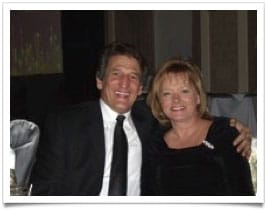
In the next semester, the graduate students were replaced by a new piano instructor, Don Beattie, who had just joined the School of Music at SIU Carbondale in 1979, coming from the University of Colorado in Boulder. Chris enrolled in group piano with this new faculty member.
Don was nothing like the graduate students. He was passionate about music and teaching, and he firmly believed there were no limits to what anyone could learn. To him, music was a birthright, and he was genuinely excited to help people learn to play, no matter where they were starting.
Chris, having already completed one semester of group piano, was eager to dive back into his scales, drills, and another song that semester—this time on the modest electric pianos in the lab. But on the very first day, Don surprised them. He told the class they wouldn’t be playing at all. Instead, he wanted to get to know them—to understand why they wanted to play piano.
The students shared their goals: one wanted to play jazz like Chick Corea, another dreamed of playing Imagine by John Lennon, while another, a flute major, flatly said he had no interest in piano and was only there to fulfill a requirement. Finally, they got to Chris. Looking down, speaking humbly, he said that someday—he was thinking decades from now—he hoped to play a Bach fugue. Fugue-playing is notoriously challenging, requiring mastery of intricate, interwoven melodies. Chris felt almost silly saying it aloud. Don simply said, “That’s very ambitious,” in a tone that Chris, at the time, took as gently dismissive, like an adult humoring a child who says he wants to be an astronaut.
Weeks passed before they ever touched the piano. Instead, Don had them learning several simple five-note songs—pieces he had written specifically for these classes. But they didn’t learn them by reading or playing. They learned them by walking them, clapping them, singing the melodies first with words, then in solfège (do-re-me), shaping the melodies with sweeping hand gestures, and using hand signs for each note—later Chris would learn this was part of the Kodály method.
🗺️ Mapping
Don mapped out these simple songs in C major, then had them transpose them into different modes and keys, always singing note names, fingerings, and whether the keys were black or white. They knew these songs backward and forward—literally—by the time he finally handed out the sheet music. Then he said something unexpected: “I think you’re almost ready for a recital.”
The class froze. Don’s teaching had been manic, fun, and wildly creative—but this was judgment day. And then he added, “There’s only one rule for your performance: you cannot play it as written.”
He showed them how to slow it down, speed it up, change keys, add pedal, vary dynamics—how to shape and reinterpret the melodies to make them their own. The creativity Don unleashed for that recital amazed Chris. In the months that followed, Don ignited in him a volcano of enthusiasm, curiosity, and relentless learning. Chris was hooked.
He began doubling down on music classes, even when his guidance counselor objected, saying he wasn’t a music major and couldn’t register for so many “electives.” Chris fought for it and won, taking full responsibility for what the counselor called his “folly.”
🏴 France
At the same time, he got an invitation to spend the summer in France from a former roommate at UNO. Suddenly, he was cramming French like his life depended on it. He spent two months there, bumbling, stumbling, and finally, actually speaking French—sort of. It was a humbling realization: there was a whole world out there, and he didn’t know much about any of it. When he got back, he switched his major from cinematography to linguistics, because clearly, words needed some work. But he wasn’t ready to give up music, especially his group piano class with Don.
It didn’t take long to realize the rest of the music school was a different universe—old-school, rigid, and honestly, pretty mediocre.
Still, everyone knew more than he did, so he absorbed whatever scraps of knowledge they’d let him have. But it wasn’t all sunshine and sonatas. He got regularly humiliated for his lack of “talent” or experience. His ear training teacher, in particular, was brutal. One day, she just looked at him and said, point blank, “You should quit music.”
Furious, he stormed into the School of Music director’s office the very next morning to file a complaint—only to discover that the ear training teacher was the director. He didn’t back down. He still gave him an earful, then promptly went back to class.
Most of his other music classes weren’t much better, feeling more like medieval torture chambers than places of learning. But he pushed on. Why? Because Don’s group piano class was gold. It was fun, inspiring, and wildly effective. Honestly, it was a miracle course, disguised as a simple group piano class, and it kept him hooked.
🎹 Bach
Less than two years after starting with Don, Chris was bracing himself for what he thought would be his final semester in the two-year group piano course. But on day one, Don handed him a copy of Bach’s Little Fugue in C Major and said, “I think you’re ready.”
Ready? Chris blinked. They hadn’t talked about that lofty dream in almost two years, but Don had a memory like an elephant-or-or — maybe just a persistent piano teacher. Now, the gauntlet was thrown.
Chris stared at the fugue. The sheet looked like a battlefield of black notes, more than anything he’d ever seen. It was like a music version of Where’s Waldo? Except instead of finding Waldo, you had to find where the heck to put your fingers. Could he possibly live up to this? After all, this was Bach — the guy who invented musical math and made it look effortless.
Determined not to let his mentor down, Chris bought a second-hand piano (the kind that smelled like a mix of old books and mystery), went home, and dove in.
🎼 Traditional Music Notation
And that’s when he met the barbed wire of traditional music notation. It nearly made him want to run screaming into the night. This wasn’t just complicated — it was like trying to read Einstein’s theory of relativity... in hieroglyphics... while juggling flaming torches.
What chance did he have to learn this monster in a single semester? Or even before graduation?
Well, stubbornness — and maybe a sprinkle of madness — kicked in. Ignoring the School of Music director’s advice to quit (which, frankly, made Chris want to punch a wall), he took Bach’s famous line—“Just play the right notes at the right time”—very literally. He decided to decode the fugue measure by measure: first right hand, then left, then together, memorizing every note like it was a sacred text. (Spoiler: it felt a bit like memorizing the Bible. Or maybe just the whole Game of Thrones series.)
Two months later, after two hours of daily practice, he had the piece memorized, note by note, but it was nothing like music yet. More like a stretched-out, broken slinky. Every time he lost his place, he had to start over. (Cue the existential dread.)
Another two months of grinding later, he finally played it in rhythm and tempo, from start to finish, just in time for the end-of-semester recital. Christmas came early that year, though this was no Silent Night. More like Nailed It Night.
That fugue, and the grueling process of learning it, liberated Chris. Suddenly, he felt ready to tackle any musical challenge. Sure, it took him weeks longer than those childhood prodigies who read music like it was candy, but hey, he had sixty years to catch up. No rush.
Over the next two years, Chris kept studying with Don—auditing his classes, soaking up his piano pedagogy methods, and realizing this wasn’t just a one-man show. Don’s teaching approach was like a breath of fresh air, natural, inspiring, and something anyone could learn and pass on.
Meanwhile, Chris stayed true to his “real” major, linguistics. He took Chinese, Spanish, more French, some Japanese, and started diving into two fascinating areas: historical linguistics (how languages change over time, like a linguistic soap opera) and developmental linguistics (how toddlers everywhere magically figure out their native tongue—something college language classes could definitely learn from).
The Language Of Music
Because he struggled with musical notation, Chris started seeing it as a kind of strange, ancient language — full of odd symbols and rules nobody quite remembers. Naturally, he became curious about where this code had come from and how it evolved. (Some of that historical detective work you’ve read about in our opening article.)
He then began comparing how music was taught to how people learn languages, especially how children acquire their native tongue. Kids first spend a long time absorbing and understanding words they can’t yet say — a sort of deep, passive learning phase.
Chris realized he, and millions of others, were stuck at that same level with music: enjoying it deeply but unable to express it, read it, or “speak” the language of music on even a basic level. But he understood that music notation isn’t the music itself. Just as some people learn languages by immersion or improvisation rather than grammar drills, people could bypass music notation and get to the music first.
Don had quoted the great Franz Liszt: “Music first, then studies.” Just like Don’s classes, where weeks of making music came before even seeing the sheet music.
Chris thought: What if we learned music like language — hearing first, then playing, then reading, and only then learning theory? That process is hardwired into every child’s brain, letting them become fluent in their native tongue by age six or seven. What if music could be taught that way? What if we could create a generation of Mozarts who speak music natively?
Music is complex...or is it?
But of course, it wasn’t that simple. Don took weeks to teach college students simple folk songs. Music is complex, and there’s a big problem: feedback. Children learning a language are surrounded by fluent speakers who correct their mistakes instantly and constantly. With music, experts are rare, expensive, and often unreachable. Mozart was lucky to have a musician dad, but that’s a rare exception, not a scalable solution.
By this time, Chris was close to graduating with a B.A. in Linguistics and a minor in French. When he looked for a music minor, the school didn’t offer one. But they did have a “general degree in music” — no special focus, just a certain number of music classes.
He did the math and realized he could take about fifteen more credit hours and graduate with a double degree in Music and Linguistics. Though some teachers were annoyed by his constant questioning of their assumptions, he managed it. Thanks to Don, Chris graduated with a music degree despite having no childhood lessons and starting music education in college.
By then, he could play dozens of pieces by Bach, Debussy, Chopin, Bartok, and others — but still couldn’t really “read” sheet music. Instead, he decoded, memorized, and analyzed the pieces like a musical codebreaker. He knew there had to be a better way. A few months after graduating in 1983, having (not-so-successfully) taken a couple of typing classes, Chris discovered a typing game on a Lisa II Apple computer. Soon, he was typing 40 words per minute. That’s when the idea struck: what if a piano video game could teach music the same way?
He put the idea aside and prepared to study Ethnomusicology at UCLA, with a future thesis exploring how some cultures seem to learn music as naturally as children learn language.
Brazil
Chris landed an exchange program through his master’s at UCLA and snagged a two-year fellowship to do research in Brazil — a country where music isn’t just background noise; it’s practically a national sport. Naturally, he volunteered himself as a guinea pig to figure out how Brazilians teach and learn music. He dove headfirst into Carnival culture, joining “escolas de samba” (samba schools), choruses, “blocos” (smaller percussion bands), and even took guitar lessons.
His biggest eye-opener came in one of these samba schools, which, despite the name, is less like a classroom and more like a buzzing social club.
Being the token “gringo” researcher, Chris was allowed to practice with the drummers — a privilege usually reserved for seasoned pros. These percussion ensembles pack nearly 40 to 50 bass drums, plus dozens of other percussionists, all playing together while the club belts out their chosen Carnival theme song... on repeat. Like, 20 to 30 times per night. If you thought Twinkle Twinkle Little Star was relentless, try this.
This marathon reminded Chris of the Suzuki method, where kids obsess over one song (usually Twinkle) until they’ve absorbed every musical nuance—harmony, rhythm, melody, phrasing—the works. For Brazilian culture, the samba rhythm was their Twinkle Twinkle - their musical foundation, learned deep in their bones.
Despite the repetition, Chris still struggled with the tamborim part — a tricky little percussion instrument with entrances so subtle and random they might as well have been secret handshakes. Plus, the bass drums were blasting so loud it felt like standing next to 40 cannons firing simultaneously behind him. He loved music, but wasn’t ready to sacrifice his hearing just yet.
So, in a brilliant moment of self-preservation, he tried earplugs. How he’d learn anything muffled through earplugs, he had no idea. But better a bit deaf than fully deaf, right?
The Visuals Of Music
With his ears muffled, Chris had to sharpen his eyes instead. He tuned into the tiniest visual cues — slight movements from the percussion leader, the way his fellow tamborim players braced themselves. By focusing on these subtle signals and mimicking hand motions, he nailed the intricate entrances and patterns in a single night — the very ones that had evaded him for weeks.
Boom. Visual cues were the secret sauce to mastering rhythm, his notorious nemesis.
And of course, it made sense. Samba culture isn’t just about sound; it’s about movement and connection. Most Brazilians learn samba through dance, watching and copying others to lock into the rhythm. Two-year-olds try to samba, eyes glued to parents and siblings, learning their Twinkle Twinkle — samba style.
Chris dove deeper into his research and started exploring other rhythms, including the hypnotic, complex drumming used in Afro-Brazilian religions. Now, since he wasn’t a member of those religions, they weren’t exactly handing out drum lessons like candy, but they did let him videotape the rituals. Back in the States, he painstakingly transcribed these rhythms frame by frame, watching the tapes in slow motion with the sound off (because at that speed, it’s more like a strobe light show than music).
He managed to transcribe 26 previously unknown sacred rhythms, which he later played back for the cult leaders. They were stunned — seriously, jaws dropped. “Who taught you this?” they asked. When Chris admitted he’d learned it all by watching the tapes for his thesis, they nodded in approval... but only for scholarly use. No dropping those beats at the next party.
This experience hammered home an important lesson: visual cues can be just as powerful as sound when learning music.
Moving on to the guitar, Chris noticed a similar pattern. Initially, he tried to unlock the secrets of the Brazilian guitar with music theory — a bit like trying to solve a Rubik’s Cube blindfolded. But soon his teacher dropped the bomb: “Look, all those fancy jazz chords? They’re just the same four fingers doing their thing. Theory’s nice, but fingers on the right frets are where it’s at. Watch me. Copy me.”
Cracking the code
That simple advice cracked the code wide open. Within a year, Chris learned hundreds of classic Brazilian songs — mostly by watching, listening, and copying. The right hand was the tricky part, mimicking different percussion instruments in a samba band, all playing independently yet perfectly together. Trying to transcribe these rhythms into sheet music was torture; only careful watching and modeling did the trick.
Often, guitars would circulate among groups, each player knowing different songs. Everyone’s eyes darted between fretboard and right hand, trying to keep up with chord changes and rhythms on the fly. Chris realized that a key part of learning music, like language, is a safe, supportive environment. Brazilians were endlessly patient and encouraging, treating his thousands of mistakes like part of the party. Every correct chord was met with cheers, just like a toddler’s first “mama” or “papa” — warm, welcoming, and full of love.
In the end, Chris learned music by playing, not studying; by watching, not just listening or decoding. His eyes told him more than his ears at first. Only once he’d built a solid base did his ears help him polish and perfect the sound. Amazing! Obvious! So much easier! If only this approach could be applied to piano — if only there were a game like those typing games he’d finally mastered, but for music notation.
All these ideas simmered in Chris’s mind as he used his Linguistics degree to teach English in Japan, then Botswana with the Peace Corps. He returned to Brazil, got married, taught English, and got interested in computers. By this point, he’d learned piano, percussion, guitar, and flute — all as an adult — and spoke French, Spanish, Portuguese fluently, with some Japanese and Setswana sprinkled in.
Chris was fascinated by how people learned languages and music in so many different cultures. He saw their similarities and differences, and began asking big questions: How alike are music and language? And how might we borrow from each to make learning both easier and more joyful?
MIDI
Most of all, he wished he could read music better. With his interest in computers, in the early 90s, he accompanied the popularization of a music language for computers called MIDI. This allowed computers, composers, and instruments to all speak to each other, and some programs came out that allowed people to manipulate music the way word processors allowed people to better manipulate words. He began to play with it, with his learning ideas still circling in his mind, and then one day he saw a different “view” of a piece of music as an option, something called “piano roll notation”.
It looked like this...
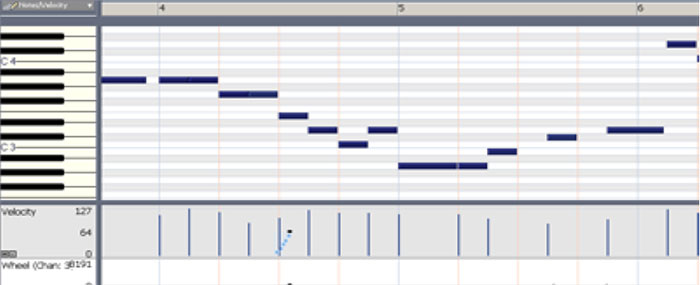
...and was the visual bridge between the mathematical and logical way that the computer interpreted music notation, and actual sheet music.
Musical Notation
After years of study, countless hours of rote learning, and wrestling with the tangled mess of traditional music notation, he finally had an epiphany. Despite what Bach and his guitar teacher had said—“just hit the right notes at the right time”—there had to be a simpler, clearer way to capture that exact idea. The centuries-old, confusing system of music notation was holding him back.
Of course! Computers couldn’t be expected to understand that archaic maze of symbols—it was too illogical! Instead, MIDI boiled it down to a brilliantly simple formula: X equals pitch (or tone), and Y equals time. Picture a neat grid—each note’s position tells you when to play it, and its length shows how long to hold it. Assign different voices to different parts, and suddenly, you have a straightforward, powerful way to view and manipulate every piece of Western music ever written.
MIDI: collective genius in its purest form.
Except it was about 100 years old, as old as piano rolls from the late 1800s.
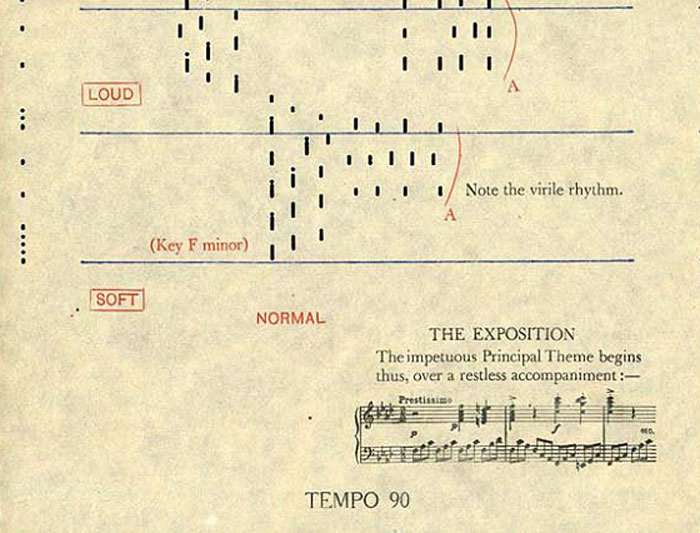
It was just music in digital form, but way better than traditional notation and seriously useful. Chris started wondering: how could this tech actually teach people? Tons of programs popped up, but they either catered to hardcore music geeks or just gave you interactive sheet music.
The problem? Starting with notation is like starting at the top of a mountain—you lose a lot of people right away. No surprise these apps flopped.
So the real challenge: how do you make it so simple anyone can jump in and play, but still lead them deeper into music and notation? How do you avoid trapping users in a dead-end app with no room to grow?
The Colors
Chris started thinking about colors—not just the boring white notes, but every single note on the keyboard. The software’s color-coding had to match the keyboard, too. Playing by color wasn’t a new idea; it’d been around forever. But most systems barely scratched the surface and ignored the black notes.
If you want MIDI to work for every song on every keyboard, you’ve got to cover all twelve notes in an octave. But here’s the catch: a straight-up color wheel means adjacent colors look way too alike. Kids would get lost in a rainbow blur faster than you can say “Oops!” Plus, distinct colors aren’t exactly unlimited—you run out faster than snacks at a kids’ party.
For years, Chris obsessed over every little detail, turning it over in his brain until it felt like it might explode. He joked he’d get a brain tumor if he didn’t get the solution out soon!
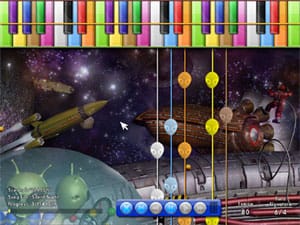
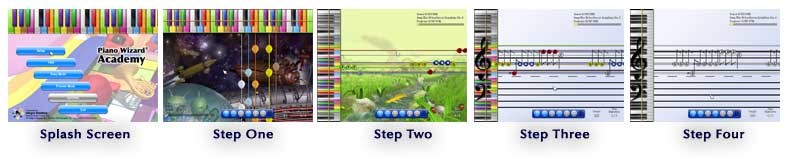
Chris started a company, borrowed some money, and hired a programmer. Spoiler alert: the programmer turned out to be a scam artist, leaving Chris with nothing but debt and a very expensive lesson in “due diligence.” Undeterred, he hired another programmer. Same story. At this point, Chris was starting to think his entrepreneurial journey was sponsored by Murphy’s Law.
Finally, he found a cooperative network of entrepreneurs who knew what they were doing—people who helped him build a company that attracted real capital, protected everyone involved, and aimed for a win-win. With genuine resources and support, Chris dove in and slowly built the first working prototype.
He tested it on his son, who loved it — and it worked! But Chris needed more proof. So he brought the game to his son’s Montessori school. Four hours later, after every kid had a turn playing “Twinkle Twinkle Little Star” on the game, shouting out colors and cheering each other on, with none scoring less than 60% on their first try and several hitting 100%, Chris knew his gut feeling was right. This wasn’t just a fun toy; it was something meaningful—something every kid could benefit from.
When he finally raised enough capital and built the full version, it got rave reviews, glowing testimonials, and even some awards. But Chris quickly realized something important: while the tool was powerful, it wasn’t perfect. Its strengths also brought weaknesses, gaps that needed filling. Life isn’t a straight line, and as Chris sought advice, capital, and strategic partners, he reached out to his former piano teacher, Don, who’d been a steady friend all these years.
Don was proud— really proud—that his former piano newbie student had come this far. But as a seasoned piano teacher, he was skeptical. Colors, computers, digital keyboards? Nice gimmick, maybe. But could it teach real music?
The REAL Piano Wizard
One thing that always set Don apart as a teacher was his willingness to turn sacred cows of music into juicy hamburgers—mustard, pickles, onions, and all—if it meant feeding a love for music and sparking real breakthroughs in learning and creativity. So when Chris handed him the game, Don jumped in.
The first hurdle: hooking it up to a computer. Ugh. Don wasn’t a tech guy and didn’t want to become one. But he persisted, poking and prodding until he figured it out. He began experimenting with his college-level students, then with kids taught by his wife, Delayna.
To his surprise, Don found the game-like approach refreshingly straightforward and completely non-intimidating. Soon, he and Delayna started asking all kinds of questions and grew genuinely intrigued. Don even used it to teach an older autistic man — the son of one of his Ph.D. committee professors. Both teacher and student shed tears when this man, who previously struggled through torturous rote repetition, powered through nearly a dozen songs in one session using the game.
Don was sold. He called Chris, making a call that transformed this cool, innovative game into a real teaching system—one that could take anyone from zero to genuine music skills in record time. Plus, it helped parents bond with their kids while learning music together.
Don offered a few polite observations, but coming from the man who’d gifted Chris music all those years ago, they carried weight. The biggest critique? The “Easy Mode” song set wasn’t easy—a random jumble of folk tunes and classical pieces, including the William Tell Overture (aka Lone Ranger music) for two hands—impossible at tempo for beginners.
Chris admitted the arrangements lacked teaching organization. That’s when Don made his move. “Mind if I experiment and arrange the songs in a more progressive, teaching-friendly order?” he asked.
Chris knew the program had official approval. With Don and Delayna’s combined 50 years of teaching wisdom, plus dozens of simple piano pieces, they were about to design a curriculum that would elevate the game— crafted by two of the smartest, most passionate music teachers Chris knew.
The Piano Wizard Academy
Chris fully supported Don and Delayna—he sponsored games, keyboards, handled logistics, and provided the financial fuel to keep the project moving. Meanwhile, Don and Delayna gathered about 20 kids from the Child Development Center and integrated the game into their daily piano lessons. They tested, retested, and tweaked new songs with both college students and curious beginners. This whole adventure quickly earned the nickname “the Piano Wizard Academy.”
And wow, did the magic happen. Videographers captured the kids’ progress, parents gushed in interviews, and heartfelt stories blossomed like wildflowers. Piece by piece, the Beatties built a world-class piano curriculum—interactive, cleverly mixing difficulty levels, and laying a solid foundation with simple yet beautifully arranged melodies. They designed a challenge shaped like an upside-down pyramid: starting with two-note melodies, then three, then five, all the way to the hundredth song—a two-handed Beethoven’s Fifth Symphony that probably made grown-ups break into a sweat.
Each song served as more than just a tune; it acted as a stepping stone, a carefully crafted musical Lego block for the next level. This turned into more than a game—it became a game with a backbone, a roadmap to real music literacy and solid training. Chris showed his excitement by offering generous stock options in addition to paying the Beatties for their arrangements and the Academy framework. The process proved tough, took longer than expected, and cost more, but everyone found joy in the work.
When they finally finished the songs, they felt pride and relief. But here’s the kicker: not even Chris, let alone most customers, fully grasped how powerful this carefully sequenced song set really was. To the casual player, it looked like a simple game. But beneath the surface, it contained dozens of hidden pathways to deep learning that most folks never understood or used. Don and Delayna uncovered these treasures during their deep dives, but for most players, these secret levels remained like hidden gems in a video game—exciting in theory, but mostly unnoticed and unplayed.
The Summer "Boot" Camp
Chris had visited the university, had crews of camera people film the progress, had seen the footage, the responses, etc., but he was curious to see it in action, and decided to stage a “Piano Wizard Music Camp” at his son’s school for a week-long summer camp. They printed out the sheet music, invited about 20 kids, brought in some of Don’s teaching assistants to help them (some of whom had changed their majors to music education after participating in the Academy experiments), and hooked up ten computers with the game.
Don and Delayna rolled in with a big whiteboard, slapped the kids’ names up there, and drew five boxes for each song. They bought shiny little gold and colored star stickers—because nothing says “You rock!” like a sticker shaped like a star. Every morning for the tiny tots (3 to 6 years old) and afternoons for the slightly bigger kids (7 to 12), they ran their workshops—about an hour a day, four days a week.
On Friday, they held a recital and invited the parents to witness the magic. Meanwhile, Chris decided to sweeten the deal for his ten-year-old son: a dollar for every song he learned across all four levels.
By Thursday, Chris was $16 poorer. By Friday, $20. And his son wasn’t the only one racking up the cash—most kids had mastered a dozen songs or more. On recital day, they played together as an ensemble and solo, reading sheet music like pros, with no tears, no tantrums—just pure joy and pride beaming from every child.
Did it work?
Chris was stunned. He’d had Don as a teacher for four years and knew he was a manic genius-level instructor. He’d played through the new curriculum himself and found it solid, well-sequenced, intuitive, and beautifully arranged—but he never imagined it would produce results like this. The whiteboard looked like a constellation of stars, the kids beamed, parents gawked, and the school director openly wept, confessing that five years of piano lessons as a kid never led to this kind of playing—or this kind of joy.
Chris realized the songs were crafted with as much science as art, as much thought as love. This wasn’t just a curriculum—it was scaffolding for building a cathedral.
And then it hit him: the game, the curriculum, and Don and Delayna’s teaching were like a piston, a spark plug, and gasoline. Together, they were more than the sum of their parts—a teaching powerhouse you could actually trust. He asked them to create video lessons for each song, sharing all the behind-the-scenes intentions, emotions, and teaching secrets they brought into the classroom.
At first, Don and Delayna went full professor mode—technical and pedagogical, like masterclasses for fellow teachers. But Chris knew their real magic was in simplifying music, making it accessible, inspiring, and downright human. Their approach built skills gently, one layer at a time, always putting music first.
Chris told them: make these videos not for piano teachers, not for non-music teachers, but for parents or anyone with zero musical experience. Start from scratch. Show them how to coach their kids to squeeze every bit of joy and learning out of the game—and the method behind it. Basically, take them on the equivalent of a year’s worth of college-level piano lessons, all taught by Don and Delayna, through this marvelous tool.
Resistance is futile
Chris and Don were super excited to show off their new game, Piano Wizard Academy, at a big fancy event called the World Piano Pedagogy Conference. Don was kind of a big deal there—he was the host and everybody liked him! 🎤🎹
But guess what? They quickly discovered that piano teachers were a lot more stubborn than they expected. These teachers weren’t really into computers and didn’t think they needed something new. It took two whole hours of showing them how fun and easy the game was before some of them finally said, “Ohhh, okay, this is actually pretty cool!” 😅🎮
The good news? The younger teachers totally got it right away. They were all in! 🙌
That’s when Chris and Don had their big “Aha!” moment. This game wasn’t really for super serious musicians—it was for kids, grown-ups, and anyone who ever dreamed of playing music but thought it was too hard. And they knew, right then and there, they had something magical.
Lights, Cameras, Action
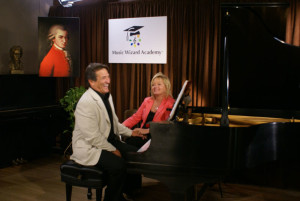
Over the next 18 months, they shot, edited, and polished 50 video piano lessons, carefully arranging each of the 50 songs into professional-level sheet music. They even whipped up notes for parents—because let’s be honest, parents sometimes need a little cheat sheet, too. Each song came with a star system: four stars for the game’s levels, and a fifth star for the grand finale—playing the piece on a real piano, sheet music in hand, no game controller required.
This was more than just a home study program; it was a musical revolution—a birthright for anyone who ever dreamed of tickling the ivories. It gave people a clear path, a sturdy foundation, and a joyous journey that would launch them into musical orbit—self-sufficient, literate, and motivated for life.
They debuted the program at the World Piano Pedagogy Conference, facing a crowd of skeptical piano teachers who kicked, poked, and prodded the $600 price tag like it was a suspiciously expensive metronome. But one by one, those teachers realized this wasn’t just another pricey gadget. This was the secret weapon for the vast majority of their students—the ones who’d dropped out or were on the verge of quitting. And the videos? Perfect for parents too, because while parents focused on what the videos taught outside the game, the teachers found they were a game-changer in tackling two perennial problems: getting students to read music and practice.
That alone made the price tag worth it, and Chris’s company sold out every single Academy they brought.
But the real magic? The true home for this program was the living room. That’s where the videos coached parents, kids practiced and played together, and a solid foundation—and enthusiasm—was built. Then, when the piano teachers stepped in, they could refine, shape, and stoke that fire.
I Can Play Piano
In 2006, Chris partnered with Fisher Price to create "I Can Play Piano." The toy connects to the TV and uses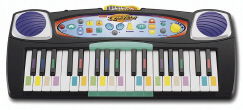 the Piano Wizard color-coded and steps method. While discontinued today, you can still find it online for sale.
And the rest, as they say, is history. Thanks to this amazing discovery, anyone can now learn to play piano—and have fun doing it.