
Introduction: The Journey That Led to Piano Wizard Academy
We’re about to introduce you to two people whose shared journey is anything but ordinary—a story driven by their pursuit of a better way.
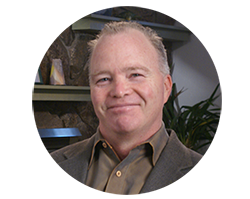 Let’s start with Chris. As a kid, Chris never took formal music lessons. He was more of a jock back then, but during his teenage years, he fell hard for rock music and often wished he had learned to play. He became a self-proclaimed rock music “expert,” the kind who knew every band, debated endlessly with friends about the greatest guitarists and the coolest piano riffs, and was thoroughly convinced that his generation’s music was the best of all time—no contest.
Then, something unexpected happened. Chris picked up a book called Steppenwolf—mistakenly thinking it was about the rock band. Instead, he discovered a story where the main character spoke about Mozart with the same awe and passion Chris reserved for Pink Floyd and Yes. It caught him off guard. Classical music had never sparked anything like that in him, but here was someone transported by Mozart in the very way Chris felt lifted by his beloved rock anthems.
Curious—and maybe a little unsettled by the idea that he might be missing something—Chris signed up for a music appreciation class at his local community college. On the very first day, the teacher began by explaining how to listen to Bach. Chris’s reaction? Ugh.
She pointed out that Bach wrote intricate, parallel, chasing interacting melodies, not just one with harmony underneath, and she charted out the little Fugue in G minor, how the main melody repeated while harmonizing in a different place, and then another and another voice, and, as he heard this kind of music for the very first time, he realized in an instant that, far from being a connoisseur of music, he was almost completely ignorant of hundreds of years of music treasures, and their beauty. It was a very humbling and enlightening moment.
Chapter 1: Classical Music
Chris became fascinated with classical music, and after watching Fantasia by Walt Disney, he was deeply inspired. The film sparked an idea—what if he could create something similar, but centered around the music of Bach, visualized the way he imagined it? Determined, he enrolled in the cinematography program at the University of New Orleans and began dreaming of producing a student film based on a Bach fugue. But he soon realized a hard truth: he knew almost nothing about music, no notation, no theory—and without at least a basic understanding, he couldn’t faithfully bring to life what he heard in his head.
Everything changed one day when he saw the Preservation Hall Jazz Band perform in New Orleans. The band was made up of elderly musicians, some nearly 80 years old, who looked frail as they stepped onto the stage. But the moment they began to play, they were transformed—radiant, electrified, utterly alive. Their joy was infectious, and they carried the entire room with them in a wave of music and enthusiasm. Chris was awestruck. That—he realized—is something I have to experience before I die. He did some quick math: at 20 years old, he might have 60 years or more to learn. In that moment, he made a vow to try—to begin a personal, spiritual, and musical journey, not for fame or approval, but to experience the beauty and happiness he saw on that stage. The thought of not trying, of letting the opportunity pass, haunted him even then; he knew it would haunt him on his deathbed.
Chapter 2: Southern Illinois University
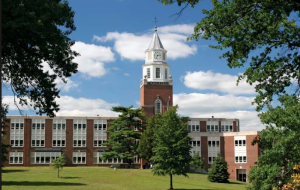 Determined to follow this calling, Chris transferred from the University of New Orleans to Southern Illinois University, still pursuing his dream of creating a film inspired by one of Bach's fugues. Along the way, he began taking elective music courses, including Basic Harmony and a Group Piano class designed for non-music majors.
It was that piano class that would change the course of his life.
The class was initially taught by two graduate students who followed a traditional approach. Week after week, students practiced scales, chords, finger exercises, and simple drills. After four months of lessons, the final assignment was to perform a Christmas carol of their choice.
Chris chose Silent Night.
Like most beginners, he nervously made his way to the piano and struggled through a slow, hesitant performance. Around him sat a dozen classmates, each waiting their turn to stumble through their own Christmas song. No one played particularly well. Everyone was intimidated. It was a familiar scene repeated in piano classrooms everywhere.
To most of the students, it was simply the end of another college course. To Chris, it was the beginning of a lifelong mission.
Although he had successfully completed the class, he couldn't ignore a nagging question.
Why did learning to play music have to be this difficult?
He knew there had to be a better way. That single question would eventually lead to one of the most important breakthroughs in his life, and years later, to the creation of Piano Wizard Academy.
➡️ Piano Lessons for Beginners
Chapter 3: The Beatties
The following semester brought an unexpected change.
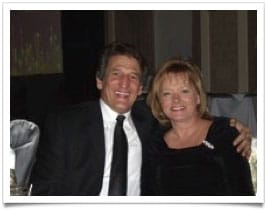
The graduate students were gone, replaced by a new faculty member named Don Beattie, who had recently joined the School of Music at Southern Illinois University after teaching at the University of Colorado in Boulder. Chris enrolled in group piano once again, curious to see how this new instructor approached teaching.
It didn't take long to realize that Don was different. He loved music. More importantly, he loved helping people discover that they could make music themselves. Don believed there were no limits to what someone could learn when they were given the right encouragement and the right method. To him, music wasn't reserved for the gifted. It was a birthright, something every person deserved the opportunity to experience.
Chris assumed the class would pick up where the previous semester had ended. More scales. More finger exercises. More drills. Eventually another simple song to perform on the electric pianos lined up throughout the lab.
Instead, on the very first day, Don did something completely unexpected.
He closed the piano lids.
"No one's going to play today," he said.
The room fell silent.
Instead of beginning with exercises, Don wanted to know why each student was there.
One by one, the students shared their dreams.
One hoped to play jazz like Chick Corea.
Another wanted to perform John Lennon's Imagine.
A flute major admitted he had no interest in piano at all and was only taking the class because it was required.
Finally, Don turned to Chris.
Chris looked down before quietly answering.
"Someday... maybe decades from now... I'd like to play a Bach fugue."
Even saying the words felt almost embarrassing.
A Bach fugue represents one of the greatest challenges in piano literature, with multiple independent melodies weaving together in remarkable complexity. It seemed almost absurd for a beginner who had only managed to struggle through Silent Night a semester earlier.
Don smiled.
"That's very ambitious."
At the time, Chris interpreted the comment as polite encouragement, the way an adult smiles when a child announces plans to become an astronaut.
He had no idea that Don genuinely believed it might one day be possible.
Then the surprises continued.
For several weeks, the class never touched the piano.
Instead, Don introduced a completely different way of learning music.
The students learned a series of simple five-note melodies that Don had written specifically for beginning classes. But they didn't learn them by reading sheet music or playing the keyboard.
They learned them by walking the rhythms.
They clapped the patterns.
They sang the melodies, first using words and later with solfège syllables, do, re, mi...
They shaped each musical phrase with broad hand movements and eventually learned hand signs for every note, techniques Chris would later recognize as part of the Kodály Method.
It was unlike anything he had ever experienced.
And although no one realized it at the time, the seeds of an entirely new approach to learning music were quietly being planted
Chapter 4: Mapping
This is a wonderful part of the story. It's where the philosophy behind Piano Wizard begins to emerge. I tightened the prose and made Don's teaching feel even more transformative.
Over the next several weeks, Don continued to surprise the class.
He mapped each of the simple five-note songs in C major, then challenged the students to transpose them into different keys and modes. As they worked, they sang every note name aloud, called out the fingerings, and identified whether each note landed on a black key or a white key. Without realizing it, they were building an incredibly deep understanding of the keyboard.
By the time Don finally handed out the sheet music, the students already knew every song inside and out, forward and backward.
Then Don smiled and said something no one expected.
"I think you're almost ready for a recital."
The room fell silent.
Although Don's classes had been energetic, creative, and filled with laughter, this suddenly felt like a moment of judgment.
Then he added one more instruction.
"There's only one rule."
"You cannot play the music as it's written."
The students looked at one another in disbelief.
Don encouraged them to make each piece their own. They could slow it down or speed it up. Change the key. Add pedal. Experiment with dynamics. Shape the phrases differently. He wasn't asking them to imitate music. He was inviting them to create it.
For Chris, it was a revelation.
The recital became a celebration of imagination instead of perfection. Every performance was different because every student brought something personal to the music.
In the months that followed, Don ignited something extraordinary in Chris, a relentless curiosity and an insatiable desire to learn. Music was no longer a class to complete. It had become a lifelong passion.
Chris threw himself into every music course he could find.
His academic advisor wasn't pleased.
"You aren't a music major," the counselor reminded him. "You can't keep filling your schedule with music electives."
Chris respectfully disagreed.
He appealed the decision, accepted full responsibility for what the counselor called his "folly," and won.
Looking back, it was one of the best decisions he ever made.
That decision set him on a path that would eventually lead to a remarkable collaboration with Don Beattie and, years later, to the creation of Piano Wizard Academy.
Chapter 5: France
This is a great section because it shows that Chris wasn't simply inspired; he persevered through real adversity. I would make it a little more polished while preserving the humor and personality.
At the same time, an unexpected opportunity came along.
A former roommate from the University of New Orleans invited Chris to spend the summer in France.
Suddenly, he was cramming French as though his life depended on it. Two months later, he found himself wandering through France, awkwardly piecing together conversations, making plenty of mistakes, and eventually discovering that he could actually communicate, at least well enough to get by.
The experience changed him.
It made him realize just how vast the world really was, and how little he actually knew about it.
When he returned to Southern Illinois University, he made another surprising decision. He changed his major from cinematography to linguistics. If language fascinated him this much, he wanted to understand how people learned, communicated, and made sense of the world.
But one thing hadn't changed.
He wasn't about to give up music, especially Don's remarkable group piano class.
As Chris ventured deeper into the School of Music, however, he discovered a very different culture.
Much of the instruction felt rigid, traditional, and uninspiring. He respected the professors' knowledge and knew they understood music far better than he did, so he absorbed every lesson he could. But encouragement was often in short supply.
Some instructors questioned his ability.
Others questioned whether he belonged there at all.
One experience, in particular, stayed with him for years.
During an ear training class, his instructor looked directly at him and said,
"You should quit music."
Chris was stunned.
The next morning, still angry, he marched into the office of the School of Music director, determined to file a complaint.
Only then did he discover that the ear training instructor was the director.
He didn't turn around.
He said exactly what he had come to say, respectfully but honestly, then walked out and returned to class.
It wasn't the last obstacle he would face.
Many of his music courses felt more like tests of endurance than invitations to discover the joy of music.
But there was one extraordinary exception.
Every week, he returned to Don's group piano class.
There, music wasn't about intimidation or perfection. It was about curiosity, creativity, and discovery. Don had somehow created a classroom where students looked forward to learning instead of fearing mistakes.
To Chris, it felt less like a college course and more like a miracle disguised as one.
It was that class, more than anything else, that convinced him there had to be a better way to teach music.
Chapter 6: Bach
Less than two years after Chris began studying with Don, he arrived for what he assumed would be his final semester of group piano. On the very first day, Don handed him a copy of Bach's Little Fugue in C Major and simply said,
"I think you're ready."
Chris was stunned.
Nearly two years had passed since he had quietly admitted that someday, perhaps decades in the future, he hoped to play a Bach fugue. He had almost forgotten the conversation.
Don hadn't.
Looking down at the sheet music, Chris wondered if his teacher had made a mistake. The pages were filled with an intimidating sea of notes unlike anything he had ever attempted. It seemed impossible that someone with only two years of piano experience could master such a demanding work.
Still, he trusted Don.
Determined not to disappoint the teacher who had believed in him from the very beginning, Chris bought a used piano and devoted himself completely to the challenge.
Almost immediately, he encountered the greatest obstacle he had ever faced.
It wasn't Bach.
It was the notation.
The music itself made sense when he heard it, but reading the page felt painfully slow and unnatural. Every measure required enormous concentration simply to determine which notes to play. It wasn't the music that was standing in his way. It was the process of decoding the symbols on the page.
For the first time, Chris experienced firsthand what countless beginners had struggled with for generations.
There had to be a better way.
Refusing to quit, he developed a systematic approach. He learned one measure at a time, first with the right hand, then the left, gradually combining them until every passage had been committed to memory. Day after day, he practiced for nearly two hours, slowly transforming a maze of notes into something he could finally understand.
After two months, he had memorized the entire fugue.
But it still wasn't music.
Every mistake forced him to stop and begin again. Progress was slow, and frustration was constant.
He kept going.
Two months later, after countless hours of practice, something remarkable happened.
For the first time, Chris performed Bach's Little Fugue in C Major from beginning to end, in tempo and with confidence, at the semester recital.
It was one of the proudest moments of his life.
But the experience left him with an even bigger realization.
If learning one extraordinary piece of music required months of decoding notation before the music could truly come alive, how many promising students had simply given up before ever experiencing that joy?
That question would become one of the driving forces behind the creation of Piano Wizard Academy.
Chapter 7: The Fugues
Mastering Bach's fugue changed Chris in ways he never expected.
The months of disciplined practice had taught him far more than a single piece of music. They gave him confidence. If he could overcome one of the greatest challenges he had ever faced, he believed he could learn almost anything.
He also gained a new perspective.
He knew he hadn't learned as quickly as students who had spent years studying music as children. But that no longer bothered him. He had discovered something far more important.
Learning was possible.
Progress was possible.
And he had a lifetime ahead of him.
Over the next two years, Chris continued studying with Don, auditing his classes whenever possible and absorbing everything he could about piano pedagogy and the art of teaching. He gradually realized that Don's success wasn't based on personality alone. It came from a thoughtful, student-centered approach that made learning feel natural, engaging, and achievable.
The more Chris observed, the more convinced he became that these ideas could transform the way people learned music.
At the same time, he continued pursuing his academic studies in linguistics. He studied French, Spanish, Chinese, and Japanese, but it was two branches of linguistics that captured his imagination.
The first was historical linguistics, the study of how languages evolve over time.
The second was developmental linguistics, the study of how children naturally acquire language.
That second field fascinated him.
Children learn to speak long before they learn to read or understand grammar. They listen, imitate, experiment, and gradually become fluent through meaningful communication. Reading and writing come later, after the language already feels natural.
Chris couldn't ignore the parallel.
If that is how human beings naturally learn language, why wasn't music taught the same way?
That simple question would eventually become one of the foundational ideas behind Piano Wizard Academy.
Chapter 8: The Language Of Music
As Chris struggled to master traditional music notation, he began seeing it differently.
The notes on the page no longer looked like music. They looked like a language, an ancient system of symbols with its own alphabet, grammar, and rules. Like any language, it had evolved over centuries, becoming increasingly sophisticated but also increasingly difficult for beginners to understand.
His background in linguistics made him curious.
Where had this musical language come from?
How had it evolved?
And more importantly, was it the only way to learn music?
The more he studied language acquisition, the more striking the parallels became.
Children don't begin life by learning grammar. They spend years listening, observing, and understanding long before they can speak. By the time they utter their first sentences, they have already absorbed thousands of words and countless patterns simply by being immersed in language.
Reading and writing come much later.
Chris realized he was experiencing the very same process with music.
Like millions of people, he loved listening to music. He understood its emotional language instinctively. He could recognize melodies, rhythms, and harmonies, yet he couldn't easily express those ideas through an instrument because he first had to decode a complex written language.
Then another realization followed.
Music notation is not music.
It is a way of representing music.
Just as people can become conversational in a foreign language through immersion before studying grammar, perhaps beginners could experience the joy of making music before becoming fluent in written notation.
Don often quoted the great pianist Franz Liszt:
"Music first, then studies."
Chris suddenly realized that was exactly how Don had been teaching all along.
For weeks, his students had sung, moved, listened, experimented, and created music before ever opening a book of sheet music.
The music came first.
The notation came later.
The more Chris reflected on that experience, the more one question refused to leave him.
What if music could be taught the same way children naturally learn language?
Hear first.
Play second.
Read naturally.
Study theory when it becomes meaningful.
If every child is born with the remarkable ability to acquire language, could that same natural learning process unlock musical fluency for millions of people who had been convinced they "weren't musical"?
That simple question became the foundation upon which Piano Wizard Academy would eventually be built.
Chapter 9: Music is complex...but does it have to be?
The idea was exciting.
But Chris also knew it wasn't that simple.
Don could spend weeks teaching a handful of simple folk songs because he was there to provide constant encouragement, demonstration, and immediate feedback. That personal interaction was invaluable.
Children learning their native language enjoy the same advantage. They're surrounded every day by fluent speakers who gently correct mistakes, model pronunciation, and reinforce learning through constant conversation.
Music presents a different challenge.
Most beginners don't have a professional musician living in their home. Private teachers can be difficult to find and expensive to maintain, making continuous guidance impossible for many families. Mozart was fortunate to grow up with a gifted musician as his father, but that has always been the exception rather than the rule.
Chris realized that if music was ever going to be learned as naturally as language, someone would have to solve the problem of feedback.
By this time, Chris was nearing graduation with a Bachelor of Arts in Linguistics and a minor in French. Hoping to continue his musical studies, he discovered that Southern Illinois University didn't offer a music minor. Instead, the university had a General Degree in Music that required a specific number of music credits.
He did the math.
With about fifteen additional credit hours, he could graduate with degrees in both Linguistics and Music.
Despite occasionally frustrating professors with his endless questions and willingness to challenge long-held assumptions, Chris completed the program.
Thanks largely to Don's mentorship, he graduated with a music degree despite having never taken music lessons as a child and beginning his musical education as a college student.
By then, Chris could perform works by Bach, Debussy, Chopin, Bartók, and many other composers.
Yet something still bothered him.
He still didn't feel like he was truly reading music.
Instead, he decoded it.
He analyzed it.
He memorized it.
He had become remarkably good at deciphering musical notation, but the process still felt more like solving a complex puzzle than reading a language naturally.
The question refused to disappear.
There had to be a better way.
A few months after graduating in 1983, another seemingly unrelated experience changed everything.
After struggling through a pair of typing classes with little success, Chris discovered a typing game running on an Apple Lisa II computer. Within a remarkably short time, he found himself typing nearly forty words per minute.
It was a revelation.
The computer wasn't simply testing him.
It was teaching him.
In that moment, an entirely new possibility emerged.
What if a computer could teach piano the same way?
What if technology could provide the constant feedback, encouragement, and repetition that beginners needed, making high-quality music instruction available to anyone, anywhere?
The idea was still only a dream.
Chris set it aside as he prepared to begin graduate studies in Ethnomusicology at UCLA, where he hoped to explore another fascinating question:
Why do some cultures seem to learn music as naturally as children learn their native language?
That question would eventually become one of the final pieces in the puzzle that led to the creation of Piano Wizard Academy.
Chapter 10: What if music could be taught the same way children naturally learn language?
Hear first.
Play second.
Read naturally.
Study theory when it becomes meaningful.
That simple question became the foundation upon which Piano Wizard Academy would eventually be built.
Chapter 11: Brazil
Chris's search for answers eventually took him halfway around the world.
Through his master's program at UCLA, he earned a two-year fellowship to conduct research in Brazil, a country where music isn't simply entertainment. It's woven into everyday life.
For Chris, it was the perfect laboratory.
Rather than observing from a distance, he immersed himself completely in Brazilian musical culture. He joined escolas de samba (samba schools), sang in choirs, performed with blocos (community percussion groups), and even took guitar lessons. His goal wasn't simply to study music. He wanted to understand how people learned music naturally within their culture.
His greatest insight came inside one of Rio de Janeiro's samba schools.
Despite the name, a samba school isn't a traditional classroom. It's a vibrant community where musicians of every age gather to rehearse, perform, and celebrate music together.
As the curious American researcher, Chris was invited to rehearse with the percussion section, an opportunity rarely offered to outsiders.
The experience was unforgettable.
Dozens of bass drums thundered through the room while scores of percussionists played together, repeating the same Carnival theme song over and over again, sometimes twenty or thirty times in a single evening.
At first, the repetition surprised him.
Then he realized he had seen something remarkably similar before.
It reminded him of the Suzuki Method, where beginning students repeatedly perform the same simple pieces until rhythm, melody, phrasing, and expression become second nature. In Brazilian musical culture, these Carnival rhythms served much the same purpose. They formed a shared musical vocabulary that became deeply embedded through joyful repetition rather than formal instruction.
Chris eagerly joined the rehearsals, but one instrument continued to frustrate him.
The tamborim, a small hand-held drum, required split-second entrances that seemed almost impossible to anticipate. To make matters worse, he was standing directly in front of forty or fifty booming bass drums, each rehearsal feeling more like standing beside a row of cannons than attending a music lesson.
He quickly realized that if he hoped to survive two years of research, protecting his hearing was probably a wise idea.
So he bought a pair of earplugs.
It seemed like a sensible solution.
What happened next would become one of the most surprising discoveries of his entire musical journey.
Chapter 12: The Visuals Of Music
Wearing earplugs forced Chris to rely on something he had barely noticed before.
His eyes.
Unable to depend on hearing alone, he began watching the smallest visual cues. A slight movement from the percussion leader. A subtle shift in posture from the other tamborim players. Tiny gestures that signaled exactly when to enter and how to play.
Within a single evening, he mastered rhythmic patterns that had frustrated him for weeks.
It was an astonishing realization.
The breakthrough hadn't come from listening more carefully.
It had come from seeing.
Suddenly, everything made sense.
Brazilian music wasn't learned through sound alone. It was learned through movement, observation, imitation, and participation. Children grew up dancing samba long before they could explain it. They watched parents, siblings, friends, and neighbors, gradually absorbing the rhythms until they became second nature.
Chris immediately recognized the parallel.
It was another example of learning through immersion rather than explanation.
Curious where this insight might lead, he expanded his research into the extraordinarily complex drumming traditions of Afro-Brazilian religions.
Because he wasn't a member of those religious communities, formal instruction wasn't available to him. However, he was given permission to videotape many of the ceremonies for academic research.
Back in the United States, he spent countless hours studying the recordings frame by frame.
Often he watched them in complete silence.
By slowing the video and focusing entirely on the drummers' movements, he carefully transcribed twenty-six sacred rhythmic patterns that had never before been formally documented.
When he later performed those rhythms for several of the religious leaders, they were astonished.
"Who taught you these?" they asked.
Chris smiled.
"No one."
He had learned them simply by watching.
That experience reinforced something he could no longer ignore.
Visual information can be every bit as powerful as sound when learning music.
The same lesson appeared again when he began studying Brazilian guitar.
At first, Chris approached the instrument the way many students do, by trying to understand every chord through music theory.
Eventually, his teacher stopped him.
"You're making this much harder than it needs to be."
Then he demonstrated.
"The same four fingers make most of these jazz chords. Don't think about the theory first."
He smiled.
"Watch my hands."
"Now copy them."
Once again, Chris saw the same principle unfolding before him.
People often learn most effectively by seeing, imitating, and doing before they fully understand why something works.
Each of these experiences pointed toward the same conclusion.
If music could be learned more naturally through carefully designed visual experiences, perhaps millions of beginners could overcome the barriers that had frustrated generations of students.
Chapter 13: Cracking the code
That simple advice changed everything.
Instead of trying to understand every chord through theory, Chris learned by watching, listening, and imitating. Within a year, he had learned hundreds of classic Brazilian songs.
The greatest challenge wasn't the left hand.
It was the right.
Brazilian guitar rhythms often imitate an entire percussion ensemble, with each finger performing an independent rhythmic role. Trying to capture those subtle movements with traditional music notation proved almost impossible. The fastest and most effective way to learn was simply to watch an experienced player and imitate what they were doing.
The same pattern appeared everywhere.
During informal gatherings, guitars were constantly passed from one musician to another. Each person knew different songs, different rhythms, and different variations. Eyes rarely stayed on the fretboard for long. Instead, musicians watched one another's hands, anticipating chord changes and rhythmic patterns while learning new songs in real time.
Chris noticed something even more important.
No one was afraid to make mistakes.
Friends encouraged one another. Every successful chord progression was celebrated. Every mistake was treated as a natural part of learning rather than something to be criticized. The atmosphere reminded him of the way parents encourage young children learning to speak. A toddler's first "Mama" or "Dada" isn't judged for its imperfections. It's celebrated because communication has begun.
Music, he realized, flourishes in exactly the same kind of environment.
By the end of his research, Chris had reached a remarkable conclusion.
He had learned music by playing, not by studying.
By watching, not simply by reading.
By participating, not by memorizing rules.
His eyes often taught him before his ears, and his ears refined what his hands had already begun to understand.
The experience reinforced a question that had been growing in his mind for years.
What if this natural way of learning could be applied to the piano?
What if technology could provide the same kind of visual guidance, immediate feedback, encouragement, and repetition that had helped him learn languages, Brazilian music, and even typing?
The idea refused to leave him.
Over the years that followed, Chris continued exploring that question while teaching English in Japan and later serving in Botswana with the Peace Corps. He returned to Brazil, married, continued teaching, and developed a growing fascination with computers and educational technology.
By this point, he had learned piano, guitar, percussion, and flute, all as an adult. He had also become fluent in French, Spanish, and Portuguese, while studying Japanese and Setswana along the way.
Every new language and every new musical culture reinforced the same observation.
People learn best when they are immersed in meaningful experiences, encouraged to experiment, and given the freedom to make mistakes.
The more Chris studied how people acquired languages and music around the world, the more one question continued to guide him.
Could the natural process of language learning become the foundation for a new way of teaching music?
That question would eventually lead to one of the most important educational breakthroughs of his life, and to the creation of Piano Wizard Academy.
➡️ Piano Lessons for Adults
Chapter 14: MIDI
Throughout those years, one goal never left Chris's mind.
He wanted to become a better music reader.
Although he had learned to perform challenging works and had immersed himself in musical cultures around the world, traditional music notation still felt like something he decoded rather than truly read. He continued searching for a more natural bridge between hearing music and understanding it on the page.
At the same time, another revolution was quietly unfolding.
During the early 1990s, computers were beginning to communicate through a new digital language known as MIDI (Musical Instrument Digital Interface). For the first time, computers, electronic instruments, and music software could all "talk" to one another.
To Chris, it was fascinating.
Just as word processors had transformed the way people wrote and edited text, MIDI software was beginning to transform the way musicians created, analyzed, and explored music. Chris eagerly experimented with these new programs, never letting go of the educational questions that had followed him for more than a decade.
Then one day, he noticed something that stopped him in his tracks.
Most music programs offered more than one way to display a piece of music.
One option was traditional sheet music.
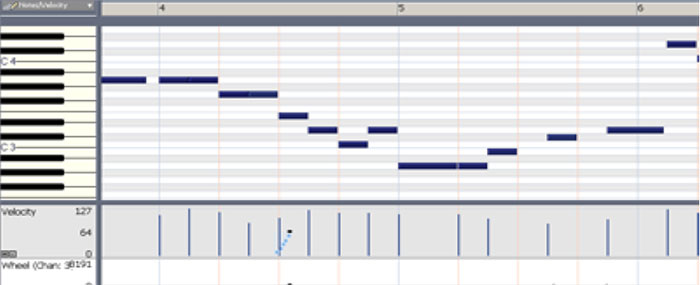
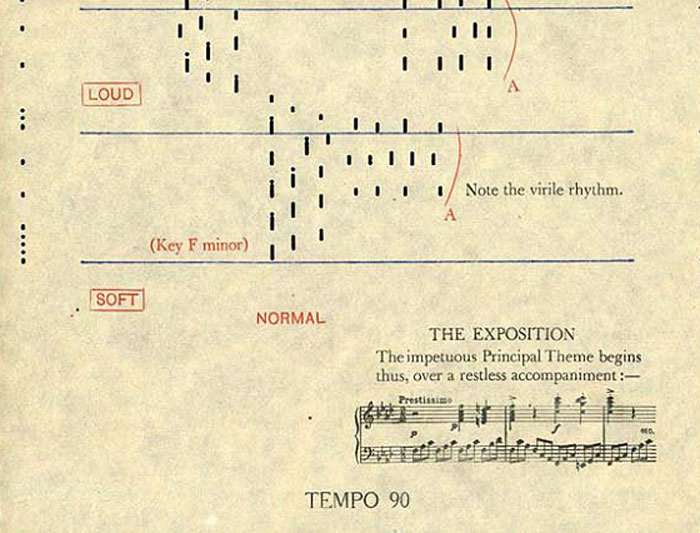
Another was something called Piano Roll Notation.
Instead of notes on a staff, music appeared as colored bars stretching across a keyboard. Pitch was shown vertically. Time flowed from left to right. Suddenly, music wasn't just something to decode. It became something you could see.
Chris immediately recognized what he was looking at.
This wasn't simply another way to display music.
It was a visual bridge between the way computers understood music and the way human beings experienced it.
For the first time, he saw the possibility of connecting visual learning, music, and technology into a single teaching system.
Everything he had learned from Don.
Everything he had discovered through linguistics.
Everything he had observed in Brazil.
Everything he had imagined since struggling through Bach.
It all began coming together.
The next chapter would transform that insight into what eventually became Piano Wizard Academy.
Chapter 15: Musical Notation
After years of study, countless hours of repetition, and struggling through the complexities of traditional music notation, Chris experienced a breakthrough.
Throughout his journey, one idea had remained constant.
"Play the right notes at the right time."
Bach had said it.
His Brazilian guitar teacher had demonstrated it.
Don had taught it in his own unique way.
So why did the written notation that represented those simple ideas feel so incredibly complicated?
There had to be a clearer way.
Then it happened.
As Chris explored Piano Roll Notation, he realized that the computer wasn't trying to interpret centuries of musical symbols at all.
It had reduced music to something beautifully simple.
Pitch.
Time.
Every note had only two essential pieces of information.
Its vertical position determined which note to play.
Its horizontal position determined when to play it and how long to hold it.
Everything else was built from those two ideas.
Different voices could be displayed on separate tracks. Rhythms became immediately visible. Musical patterns practically jumped off the screen.
It was elegant.
It was logical.
And it made perfect sense.
Chris suddenly realized that this wasn't merely another way to display music.
It was a visual language.
One that represented the same musical information found in traditional notation, but in a form that beginners could understand almost immediately.
Ironically, the idea wasn't even new.
Long before computers, player pianos had used paper piano rolls that represented music in much the same way. MIDI had simply brought that elegant concept into the digital age, giving computers a practical and intuitive way to represent every piece of Western music ever written.
For Chris, the implications were enormous.
What if beginners could learn to see music first...
...before struggling to decode centuries-old notation?
For the first time, he could clearly imagine how technology might finally solve the problem that had occupied his thoughts for more than a decade.
The vision that would eventually become Piano Wizard Academy was finally beginning to take shape.
The discovery was exciting.
Piano Roll Notation wasn't just another way to display music. It was an elegant digital representation that made music far easier for a computer to understand and manipulate than traditional notation.
But one question remained.
Could it actually help people learn?
As MIDI software became more popular, dozens of music programs appeared on the market. Most were designed for composers, arrangers, and experienced musicians. Others simply displayed interactive sheet music, assuming beginners would start by learning notation.
Chris immediately saw the problem.
For someone who already reads music, those programs were powerful tools.
For a beginner, they were often overwhelming.
Starting with traditional notation is like asking someone to read before they've learned to speak. Many enthusiastic beginners lose confidence before they ever experience the joy of making music.
There had to be a better way.
The real challenge wasn't creating another music program.
It was creating a learning experience so simple that anyone could begin playing immediately, while gradually leading students toward reading music, understanding theory, and developing lifelong musical skills.
In other words, the software couldn't become the destination.
It had to become the bridge.
That realization would shape every design decision that eventually became Piano Wizard Academy.
Chapter 16: The Colors
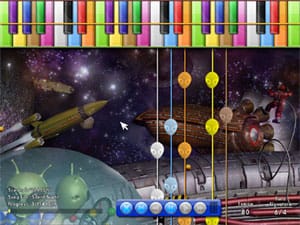
The more Chris explored the possibilities of Piano Roll Notation, the more he realized that one problem still remained.
How could absolute beginners instantly recognize every note on the keyboard?
His thoughts kept returning to color.
Not just the familiar white keys, but every note on the piano.
The visual display had to correspond perfectly with the keyboard itself, allowing beginners to understand what they were seeing without first learning traditional notation.
Color-coding wasn't a new idea. Various systems had experimented with colored notes for decades. But most were limited, focusing primarily on the white keys while largely ignoring the black keys.
That wouldn't work.
If the system was going to teach every piece of music in every key, it had to represent all twelve notes of the chromatic scale.
That presented a surprisingly difficult challenge.
Simply assigning colors around a traditional color wheel wasn't enough. Many adjacent colors looked too similar, especially for young children. After only a few notes, subtle differences became difficult to distinguish, leading to confusion instead of clarity.
Chris realized he wasn't simply choosing colors.
He was designing an entirely new visual language for music.
For years, he sketched ideas, experimented with different color systems, and mentally tested countless possibilities. The problem followed him everywhere. He would revisit it while driving, walking, teaching, or lying awake at night.
The solution had to be simple.
It had to be intuitive.
And most importantly, it had to help beginners succeed from the very first lesson.
Little by little, the pieces began falling into place.
Determined to turn his ideas into reality, Chris did what many first-time entrepreneurs do.
He started a company.
He borrowed money.
And he hired a programmer.
It was an expensive mistake.
The programmer failed to deliver, leaving Chris with little more than debt and a hard lesson about choosing the right partners.
Undeterred, he tried again.
Unfortunately, the second programmer produced much the same result.
Building educational software turned out to be every bit as challenging as developing the educational ideas behind it.
Eventually, Chris connected with a network of experienced entrepreneurs who understood both technology and business. With their guidance, he was able to build a company, attract investment, and assemble a team capable of transforming years of research into a working product.
Slowly, the first prototype began to take shape.
The first test subject was close to home.
His young son.
To Chris's delight, his son immediately loved the program. It was engaging, intuitive, and, most importantly, he was learning.
But one successful child wasn't enough to prove the idea.
Chris wanted to know whether it could work for children who had never seen it before.
He approached his son's Montessori school and asked if the students could try the program.
The results exceeded every expectation.
One by one, the children sat down to play Twinkle, Twinkle, Little Star. They enthusiastically called out colors, encouraged one another, and eagerly waited for another turn. Even on their very first attempt, every child achieved a passing score, with several earning perfect scores almost immediately.
Watching those children learn, Chris experienced another turning point.
This wasn't simply an entertaining computer game.
It was a new way to introduce people to music.
Encouraged by those early results, Chris raised additional capital and continued developing the software into a complete learning system. The finished program received enthusiastic reviews, glowing testimonials, and industry recognition.
But Chris also understood something important.
The software alone wasn't enough.
It was an extraordinary teaching tool, but like every educational method, it had strengths and limitations. To become everything he believed it could be, it needed the wisdom of an experienced educator.
There was only one person he wanted to call.
His former piano teacher.
Don Beattie.
For years, Don had followed Chris's journey with pride. The once-intimidated beginner who had quietly dreamed of playing a Bach fugue had become a musician, a researcher, and an inventor.
Still, Don approached the software with the healthy skepticism of a lifelong teacher.
Colored notes.
Computers.
Digital keyboards.
Interesting ideas, certainly.
But one question remained.
Could this really teach people to become musicians?
That question would begin the partnership that ultimately transformed a promising piece of software into Piano Wizard Academy.
Chapter 17: The real Piano Wizard
There was one quality that had always set Don apart as a teacher.
He was never afraid to challenge long-held assumptions if it meant helping students truly experience the joy of making music. Tradition mattered, but learning mattered more. If an old teaching method stood in the way of a student's success, Don wasn't afraid to rethink it.
So when Chris placed the software in front of him, Don gave it an honest chance.
The first challenge wasn't musical.
It was technological.
Connecting computers, MIDI keyboards, and software wasn't exactly part of Don's comfort zone. But he patiently worked through the learning curve until everything was finally running.
Then the real testing began.
Don introduced the program to his college piano students and, together with his wife, Delayna, began using it with the young students in her private piano studio.
What happened surprised him.
The game-like environment immediately removed much of the fear that beginners often feel. Students who were normally hesitant became curious. Instead of worrying about making mistakes, they simply wanted another turn.
The breakthrough came when Don introduced the program to an older autistic man, the son of one of the professors who had served on Don's doctoral committee.
For years, traditional instruction had been an exhausting struggle.
During a single session with the software, he successfully worked through nearly a dozen songs.
Teacher and student both found themselves in tears.
Don realized he wasn't simply looking at an engaging computer program.
He was witnessing a completely different way of introducing people to music.
He called Chris.
That phone call changed everything.
The software was no longer just an innovative game.
It had the potential to become a complete educational system capable of guiding beginners from their very first notes toward genuine musical understanding. Better still, it encouraged parents and children to learn together, creating shared musical experiences instead of isolated practice sessions.
Don was enthusiastic, but he was also an experienced teacher.
And experienced teachers always see opportunities for improvement.
His biggest observation concerned the sequence of the lessons.
The software's "Easy Mode" wasn't really organized for beginners. The songs were an assortment of folk melodies and classical pieces presented without a carefully planned progression. Some selections, including arrangements that required both hands, demanded skills that beginning students simply hadn't developed yet.
Chris agreed completely.
The software needed a curriculum.
Then Don asked a simple question.
"Would you mind if I reorganized the music into a true teaching sequence?"
Chris didn't hesitate.
There was no one he trusted more.
Together, Don and Delayna brought more than fifty years of piano teaching experience to the project. They carefully selected, arranged, and organized dozens of pieces into a progressive curriculum that allowed each new lesson to build naturally on the one before it.
The software provided the technology.
Don and Delayna provided the educational roadmap.
Together, they transformed an innovative idea into the teaching system that would eventually become Piano Wizard Academy.
Chapter 18: The Piano Wizard Academy
Chris fully supported the project, providing the funding, equipment, software, and logistical support needed to keep the work moving forward. While he continued refining the technology, Don and Delayna focused on what they did best, teaching.
Together, they invited a group of approximately twenty children from the Child Development Center to participate in what quickly became known as the Piano Wizard Academy.
Every lesson became a research project.
Songs were tested, revised, and tested again with young beginners, college students, and piano teachers. Every success and every struggle helped shape the curriculum. The goal wasn't simply to create a collection of songs. It was to build a carefully sequenced pathway that would guide complete beginners from their very first notes toward genuine musicianship.
The results exceeded everyone's expectations.
Videographers documented the children's progress. Parents enthusiastically shared their experiences. Students who had never imagined themselves playing the piano found themselves performing real music with confidence and excitement.
Over time, Don and Delayna created what would become the heart of Piano Wizard Academy.
A carefully organized curriculum.
Each song was selected for a purpose.
Each arrangement introduced one new musical concept while reinforcing those that came before it. Students began with simple two-note melodies, gradually expanded to three-note and five-note patterns, and continued building their skills one carefully designed step at a time.
By the time students reached the one hundredth song, they were confidently performing a two-handed arrangement of Beethoven's Fifth Symphony, something that would have seemed impossible when they began.
Every lesson became another building block. Every song prepared students for the next challenge. The curriculum wasn't simply a collection of music. It was a carefully engineered learning sequence.
Chris recognized just how valuable Don and Delayna's contribution had become. In addition to compensating them for their arrangements and curriculum development, he granted them generous ownership in the company because he understood that the educational system was becoming every bit as important as the technology itself.
Developing the Academy required more time, more revisions, and more resources than anyone had anticipated.
No one complained.
Everyone believed they were building something that had the potential to change the way people learned music.
When the curriculum was finally complete, there was an overwhelming sense of accomplishment.
Yet one surprising realization remained.
Most people saw Piano Wizard as an entertaining music game.
Very few recognized what was hidden beneath the surface.
Behind every song, every level, and every challenge was an intentionally designed educational sequence developed through years of classroom testing, research, and refinement. The software made learning enjoyable, but the carefully crafted curriculum quietly guided students toward lasting musical understanding.
That hidden curriculum remains one of Piano Wizard Academy's greatest strengths, and one of its best-kept secrets.
Chapter 18: The Summer "Boot" Camp
Although Chris had watched the project develop from a distance, funding the work, reviewing videos, and hearing stories from Don, Delayna, parents, and teachers, he wanted to experience the Academy firsthand.
So he organized a week-long Piano Wizard Music Camp at his son's school.
The team assembled ten computer workstations equipped with the Piano Wizard software. Approximately twenty children enrolled in the camp, and Don sent several of his teaching assistants to help, some of whom had been so inspired by the Academy experiments that they had changed their college majors to music education.
The students were given printed sheet music, digital keyboards, and the software.
Then the learning began.
For an entire week, Chris watched children who had never played the piano before eagerly gather around the keyboards. Instead of being intimidated, they were excited. They encouraged one another, celebrated each other's successes, and couldn't wait for another turn.
Something remarkable was happening.
The children weren't simply playing a computer game.
They were becoming musicians.
The same ideas Chris had spent years developing, inspired by linguistics, Don's teaching, Brazilian music, and visual learning, were now unfolding naturally before his eyes.
For the first time, he wasn't imagining that the method could work.
He was watching it work.
It was one of the most rewarding moments of his life.

To keep the children motivated, Don and Delayna created a simple but remarkably effective reward system.
A large whiteboard displayed every student's name alongside the songs they were learning. As each child mastered a new piece, they earned colorful star stickers that quickly filled the chart. Every new song became another small victory, and the children eagerly encouraged one another as they watched the stars accumulate.
The camp welcomed two age groups.
Young children, ages three to six, attended morning sessions, while older students, ages seven to twelve, participated in the afternoons. Each group met for about an hour a day over four days, gradually building confidence and adding new songs to their growing repertoire.
On Friday, parents were invited to a recital.
Chris decided to add a little extra motivation for his ten-year-old son.
He promised to pay him one dollar for every song he mastered across the program's four difficulty levels.
By Thursday, Chris had already paid out sixteen dollars.
By Friday, it was twenty.
His son wasn't unusual.
Many of the children had successfully learned a dozen songs or more in less than a week.
Then came the recital.
Parents watched in amazement as children who had arrived with little or no piano experience performed together as an ensemble and individually. Even more surprising, many were already beginning to read from printed sheet music with growing confidence.
There were no tears.
No frustration.
No fear of making mistakes.
Instead, the room was filled with smiles, applause, and the unmistakable excitement that comes from discovering, perhaps for the first time, "I really can do this."
For Chris, it was one more confirmation that the vision he had been pursuing for more than a decade wasn't just possible.
It was changing the way children experienced music.
Chapter 19: Did it work?
Chris was amazed.
He had spent four years studying with Don and knew firsthand what an extraordinary teacher he was. He had already worked through the new curriculum himself and recognized how carefully the songs had been arranged. Each lesson flowed naturally into the next. Every piece introduced a new concept while reinforcing those that came before it.
He knew it was good.
He simply had no idea it was this good.
The whiteboard was covered with stars.
Children who had never imagined themselves playing the piano were performing with confidence.
Parents watched in disbelief.
The school's director fought back tears as she admitted that after five years of childhood piano lessons, she had never experienced this level of joy, confidence, or musical accomplishment herself.
In that moment, Chris understood something profound.
The curriculum wasn't simply a collection of songs.
It was a carefully engineered pathway to musicianship.
Every arrangement had been crafted with extraordinary care, blending educational research, musical artistry, and decades of teaching experience into a sequence that quietly built one skill upon another.
Then another realization followed.
The software alone wasn't enough.
The curriculum alone wasn't enough.
Even great teaching alone wasn't enough.
Together, however, they created something far greater than the sum of their parts.
The technology made learning engaging.
The curriculum provided the roadmap.
Don and Delayna brought the wisdom of experienced teachers who understood not only what to teach, but when and why.
Only then did Chris realize that Piano Wizard Academy was never meant to be just a game.
It was a complete learning system.
Determined to preserve everything Don and Delayna brought into the classroom, Chris asked them to create a complete series of video lessons for every song in the curriculum.
At first, they approached the recordings the way college professors naturally would, filled with technical language, pedagogy, and detailed musical explanations intended for trained musicians and teachers.
Chris gently stopped them.
"That's not who these lessons are for."
He reminded them why the Academy existed in the first place.
It wasn't created for professional piano teachers.
It wasn't created for music professors.
It was created for ordinary families.
For parents with no musical background.
For grandparents.
For homeschool families.
For adults finally deciding to learn.
For anyone willing to say, "I've always wanted to play."
The videos needed to reflect the same philosophy that had inspired the entire project.
Keep music joyful.
Keep learning natural.
Build confidence first.
Let understanding grow from making music.
That philosophy remains at the heart of Piano Wizard Academy today.
Chapter 20: Lights, Cameras, Action
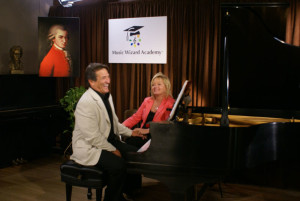
Over the next eighteen months, Don and Delayna devoted themselves to transforming the curriculum into a complete home learning system.
Together they recorded, edited, and refined fifty video piano lessons, one for each carefully sequenced song. Every arrangement was professionally engraved into sheet music, accompanied by detailed teaching notes for parents and instructors. The goal wasn't simply to teach songs. It was to teach how to teach.
Each lesson followed the Academy's five-star progression.
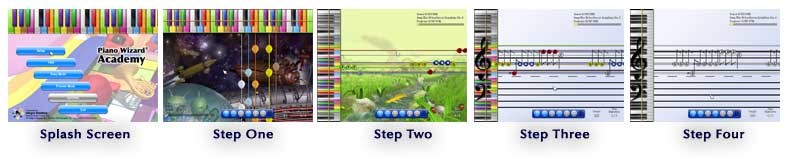
The first four stars guided students through the Piano Wizard game, gradually building confidence and musical understanding. The fifth star represented the ultimate goal, performing the piece independently on a real piano while reading traditional sheet music.
The game was never intended to be the destination.
It was the bridge.
By the time students earned that fifth star, they had crossed from visual learning into genuine music reading and independent performance.
For Chris, the vision he had carried for more than fifteen years was finally becoming reality.
The completed Academy was introduced at the World Piano Pedagogy Conference, where it was met with understandable skepticism. Many teachers initially saw only an expensive piece of software.
Then they looked more closely.
They saw a complete curriculum.
They saw professionally designed video lessons.
They saw parents becoming active partners in the learning process.
Most importantly, they saw a practical solution for the very students who so often struggled, became discouraged, or quietly gave up piano altogether.
By the end of the conference, every Academy they had brought was sold.
But the greatest success wasn't measured in sales.
It was measured in living rooms.
Parents and children were learning together.
Families were making music together.
Students were arriving at their piano lessons excited instead of intimidated.
Teachers could spend less time correcting frustration and more time developing musicianship.
For the first time, technology, curriculum, and great teaching had come together to create something neither could accomplish alone.
More than four decades after a young college student nervously told his piano teacher that he hoped to play a Bach fugue someday, the ideas inspired by that conversation had grown into Piano Wizard Academy.
What began as one student's search for a better way to learn music became a mission to help others discover the same joy.
Because music isn't reserved for the gifted.
It isn't reserved for those who began at age five.
And it isn't reserved for professional musicians.
Music is a birthright.
That simple belief continues to guide Piano Wizard Academy today, helping children, adults, homeschool families, and students with diverse learning needs discover that making music is not only possible, but one of life's greatest joys.
Continue Your Musical Journey
Whether you're a complete beginner, returning to the piano after many years, teaching at home, or helping a student with unique learning needs, Piano Wizard Academy was built to make learning music enjoyable from the very first lesson.
- 🎹 Beginner Piano Lessons
- 👨 Adults
- 🏡 Homeschool
- 🌟 Special Needs
- ❤️ Success Stories
- 🎁 Free Piano Lessons